Your landing page has one job: to turn interest into action.
Whether that action is collecting an email address, booking a demo, or completing a purchase, a landing page exists to convert visitors into leads or customers. But today, high-performing landing pages aren’t just about attractive design or clever headlines. They combine strategy, psychology, performance, and user experience into one focused conversion tool.
In this guide, we’ll break down why landing pages are critical for lead generation and how to build one that converts consistently, covering search intent and UX design, trust signals, performance, and testing.
Why Landing Pages Matter for Lead Generation
A landing page is a dedicated web page designed around a single objective. Unlike a homepage, which encourages exploration through multiple links and navigation paths, a landing page removes distractions and focuses users on one clear action.
This focus is what makes landing pages so powerful for lead generation.
Visitors typically arrive from ads, search engines, email campaigns, or social media with a specific intent already in mind. A well-designed landing page captures that intent and guides users toward the next step, turning casual visitors into potential customers (leads).
Landing pages also help businesses:
- Generate more qualified leads than general website pages
- Reduce marketing efforts by improving conversion rates
- Valuable data collection for future campaigns
- Measure user behavior and optimize marketing performance
In short, landing pages act as the bridge between marketing traffic and measurable results.
Homepage vs. Landing Page: Understanding the Difference
Although they may look similar, homepages and landing pages serve very different purposes.
A homepage introduces your brand and helps users navigate your website. It contains multiple links, sections, and entry points.
A landing page, on the other hand, is intentionally focused. It usually contains one primary goal, one main call to action (CTA), and minimal navigation or distractions.
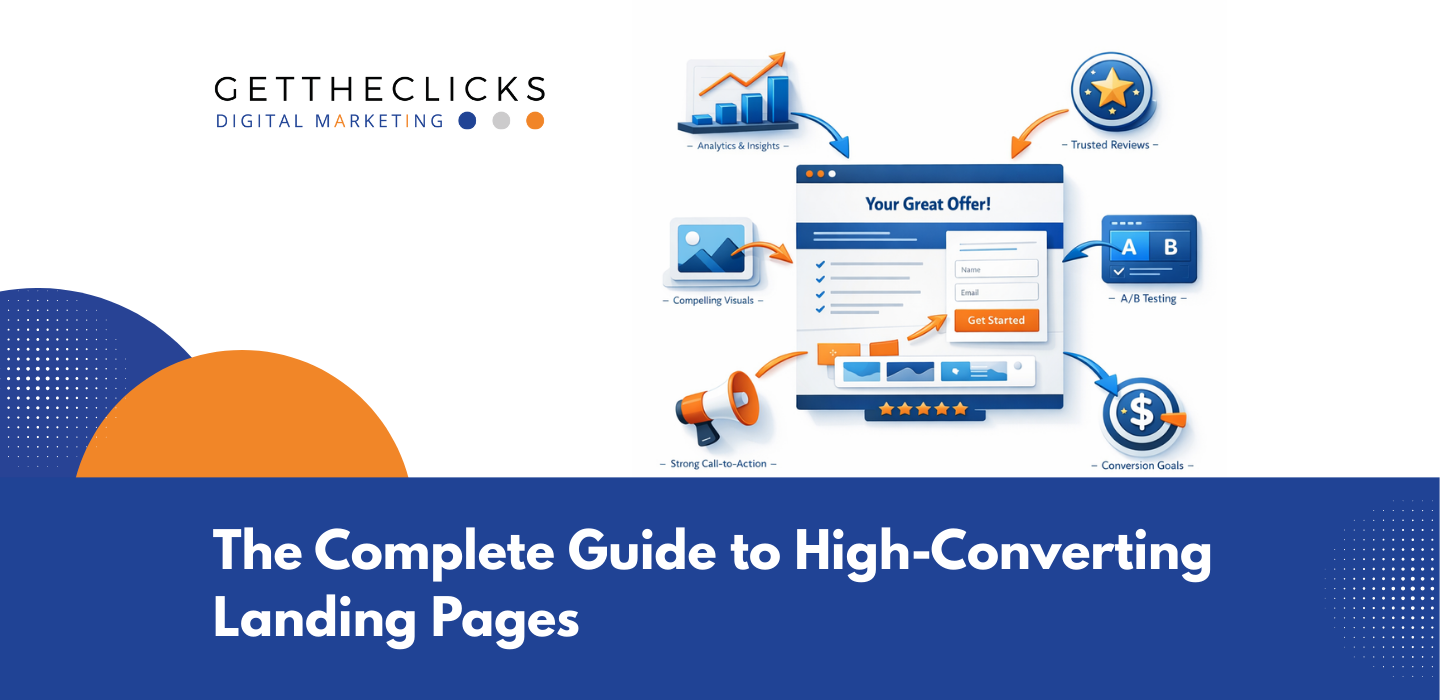
A landing page also highlights how A/B testing enhances the user experience by allowing marketers to refine focus, remove friction, and improve how users naturally move toward conversion.
This simplicity reduces decision fatigue and increases the likelihood that users will take action.
There are typically two types of landing pages:
Lead generation landing pages, which collect user information through forms, and clickthrough landing pages, which guide users toward a purchase or next step through a single action button.
Start With Search Intent and Message Match
The most common reason landing pages fail is simple: they don’t match what the visitor lands expecting to see.
Every user arrives with intent: informational, navigational, or transactional. Your landing page should feel like the natural continuation of the ad, email, or search result that brought them there.
If someone searches for a specific solution, your headline, copy, and offer should immediately confirm they’re in the right place.
Strong landing pages align headline messaging with the ad or search copy that brought the visitor there, ensuring immediate message match and clarity. They also align the offer with the visitor’s specific problem or need, making the page feel relevant and valuable from the start.
Finally, they align the call to action with the user’s stage in the sales funnel, presenting the right next step, whether that’s learning more, signing up, or making a purchase at the right time.
When expectations match reality, users stay longer and convert more often.
Optimize the Above-the-Fold Section for Immediate Impact
You have only a few seconds to grab attention once your page loads. The above-the-fold section (the portion visible without scrolling) is your most valuable space and often shapes first impressions about high-converting landing pages.
A high-converting hero section should include a clear, benefit-driven headline, a short supporting subheadline, one primary CTA, and lightweight visual elements or a video that quickly explains the offer.
Clarity beats creativity here. Visitors perceive what you offer and what to do next. Because most traffic now comes from mobile devices, this section must also be mobile-first, fast-loading, and easy to interact with.
Build Trust Before Asking for Action
People don’t convert when they’re unsure. Trust is one of the strongest drivers of conversion.
Your landing page should actively reduce hesitation by showing credibility and minimizing perceived risk.
Effective trust-building elements include:
- Customer testimonials and reviews
- Case studies with measurable outcomes
- Client or partner logos with context
- Guarantees or refund policies
- Security badges or certifications
Place social proof near CTAs to reinforce confidence at decision points.
Address common objections directly through FAQs or short explanatory sections. When users feel informed and reassured, converting the landing becomes easier.
Apply UX Principles That Guide Users Naturally
A confusing layout kills conversions faster than weak copy.
Effective landing page design uses UX principles to guide attention and reduce cognitive load. The goal is to make the next step feel obvious and effortless.
Best practices include a clear visual hierarchy using headings and spacing, and scannable sections with bullet points. Also, use generous white space to reduce cognitive overload and improve readability. It allows important elements, such as headlines and calls to action, to stand out.
Minimal navigation and distractions help keep users focused on the primary goal, while a logical content flow from problem to solution to proof and finally action guides visitors naturally through the decision-making process and toward conversion.
Every element should support the primary goal of the page.
Accessibility also plays an increasingly important role in UX. Proper contrast, readable typography, keyboard navigation, and descriptive image alt text improve usability for everyone while strengthening SEO and trust.
Create CTAs That Actually Drive Clicks
Your call to action is where conversions happen, so it needs to be intentional.
Strong CTAs use action-oriented language, such as “Get My Free Quote,” rather than generic terms like “Submit.”
They remain clearly visible throughout the page, are placed after key persuasion points where users feel confident taking the next step, and are designed with strong visual contrast to stand out and be easy to identify at a glance.
Including a CTA above the fold and repeating it at natural page breaks keeps users moving forward without forcing them the make a decision too early.
Adding urgency or clarifying the next step (“Download instantly” or “No credit card required”) can further reduce friction.
Simplify Forms to Reduce Friction
Long or complicated forms create hesitation and abandonment.
For lead generation, only ask for essential elements. Name and email are often enough for initial conversions. Additional data can be collected later.
High-converting landing pages include clear labels instead of placeholders, inline validation with helpful error messages that guide users in real time, and privacy reassurance near submission buttons to reduce hesitation.
They should also clearly explain what happens next after submission, setting expectations and helping users feel confident about taking the next step.
For higher-commitment offers, multi-step forms with progress indicators can feel less overwhelming than a single long form.
Prioritize Speed, Performance, and Mobile Experience
Performance directly impacts conversions. Slow pages increase bounce rates and reduce trust.Modern landing pages should prioritize fast loading times, especially the initial content load, and minimize layout shifts that can disrupt the user experience.
They should feature a responsive, mobile-friendly design, compressed and optimized images for faster performance, and limited third-party scripts to reduce unnecessary delays and maintain smooth interactivity.
Testing on real devices and over slower connections ensures your experience works for all users, not just those on fast networks. Avoid low-quality images that can damage credibility; instead, use high-quality, visually appealing images.
Measure, Test, and Continuously Improve
Landing pages are never finished. The best-performing pages evolve through testing and data analysis.
Use analytics and A/B testing to compare different versions of elements such as headlines, CTA wording and placement, images or demo videos, form length, and overall layout variations.
Testing these components helps identify what resonates most with users, allowing you to make data-driven improvements that steadily increase engagement and conversion rates over time.
Track both primary conversions (form submissions, purchases) and micro-conversions like scroll depth, clicks, or video engagement. These insights reveal where users hesitate or drop off. Testing removes guesswork and turns optimization into a measurable process.
Common Landing Page Mistakes to Avoid
Even well-crafted landing pages can underperform when basic principles are overlooked. Watch out for:
- Too many choices or competing CTAs: Presenting multiple actions at once can overwhelm users and make it harder for them to decide what to do next.
- Vague or benefit-free messaging: If users can’t quickly understand how your offer helps them, they’re unlikely to stay engaged or convert.
- Slow load times: Pages that take too long to load increase bounce rates and reduce trust before users even see your content.
- Hidden or unclear calls-to-action: When users can’t easily find or understand the next step, conversions drop because momentum is lost.
- Excessive form fields: Asking for too much information upfront creates friction and discourages users from completing forms.
- Poor mobile usability: A page that’s difficult to read or navigate on mobile devices drives users away since most traffic now comes from phones.
A successful digital marketing campaign needs a good landing page that feels simple, focused, and intuitive from start to finish.
Final Thoughts: What Winning Landing Pages Look Like
Landing pages that generate leads and conversions today share the same core characteristics:
- Focused: One clear goal and minimal distractions
- Fast: Optimized for performance across devices
- Trustworthy: Rich with proof and transparency
- Accessible: Usable by everyone
- Data-driven: Continuously tested and improved
When strategy, design, and user-centric design align, a landing page becomes more than just a standalone page; it becomes a predictable engine for growth.
Test often. Measure everything. Optimize continuously.
Turn Your Landing Page Into a Conversion Engine with Get the Clicks
Ready to turn more visitors into qualified leads and measurable growth? Get the Clicks designs high-performing landing pages that combine strategy, speed, and persuasive messaging to maximize conversions. Partner with our team to audit, design, and optimize your landing pages so every click moves your business closer to results today.