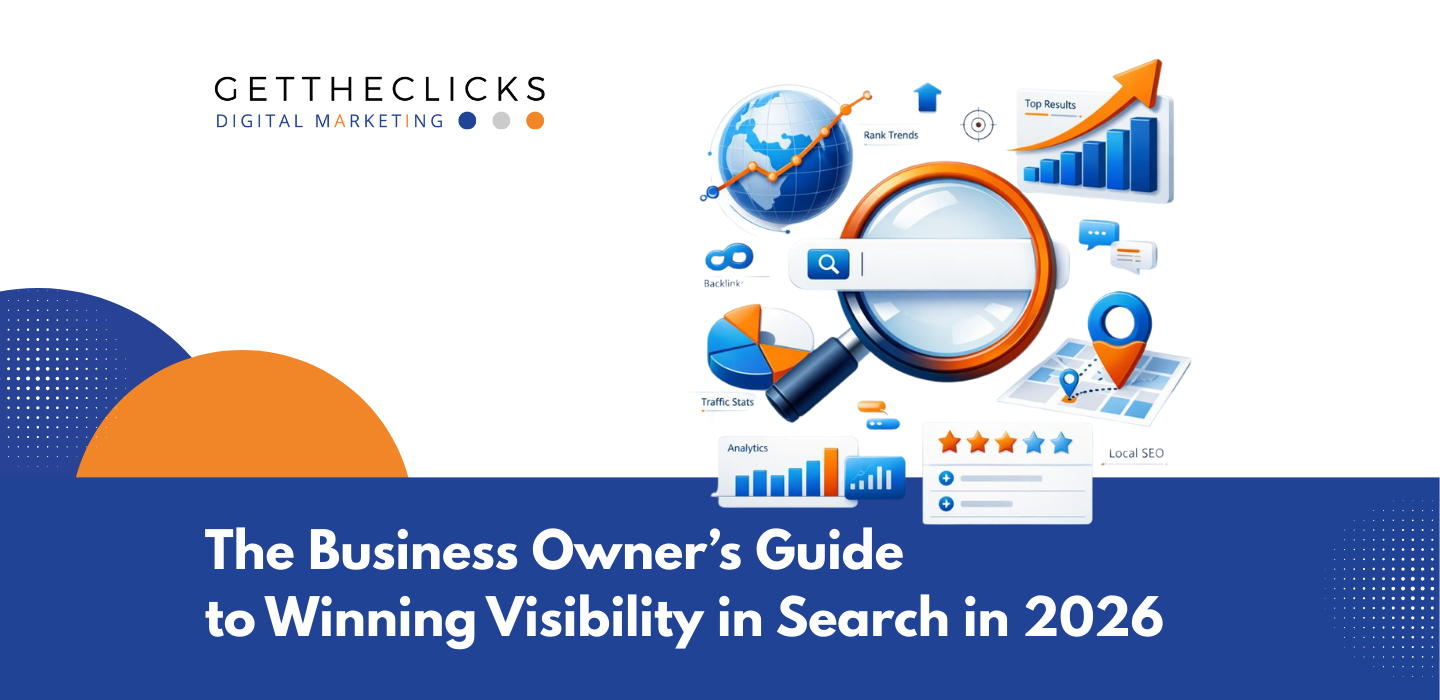
Search is changing fast, but the goal is the same: get found by the right customers and turn that visibility into leads. In 2026, Google rankings are influenced by more than keywords. Search results now include AI summaries, map results, FAQs, and other features that can win (or steal) attention before someone even clicks a website. Google’s AI Overviews began rolling out broadly in the U.S. in May 2024, which changed how many searches look and how clicks are distributed.
If you’re a business owner evaluating SEO services, use this guide as a practical checklist. You’ll know what matters, what’s outdated, and what a strong SEO agency should be doing each month.
The 2026 SEO checklist (quick takeaways)
- Build topical authority with content that answers real customer questions
- Make trust obvious with proof, reviews, and clear business information
- Optimize for local SEO (Google Business Profile, reviews, location relevance)
- Fix technical issues that block Google from reading your site properly
- Improve user experience and site speed (Core Web Vitals, especially INP)
- Use structured data where it helps (a small “label” for Google)
- Earn quality mentions and links (local and industry, not spam)
- Measure what matters: calls, forms, booked jobs, and sales
1) Build topical authority so Google trusts you for your category
Topical authority means your site consistently covers a topic in a way that’s thorough, helpful, and easy to navigate. It is not one blog post and a few service pages.
What this looks like on a business site
- A strong “money page” for each core service (for example, SEO, web design, Google Ads)
- Supporting pages that answer pre-buying questions:
- pricing and what impacts cost
- timelines and what to expect
- comparisons (“X vs Y”)
- FAQs and common objections
- Internal links that connect everything so Google and customers can find the next step
Simple action step:
Create 8 to 15 content topics based on the questions your customers ask most. Publish consistently and link each article back to the relevant service page.
2) Content for humans first (because Google is rewarding usefulness)
Google’s own guidance is clear: it wants helpful, reliable, people-first content.
In practical terms, generic “SEO tips” posts are harder to win with, especially when AI can generate similar content in seconds. Your advantage as a business is real experience.
What “helpful” content looks like in 2026
- Specific answers (not vague advice)
- Real examples from your work (screenshots, photos, before-and-after results)
- Clear steps a person can follow
- Updated information (refresh important pages regularly)
- Content written or reviewed by someone with real experience
If you hire SEO: ask how the agency will show real expertise and real results, not just publish high word-count articles.
3) Win visibility in AI Overviews and modern search results
AI Overviews and rich search features reward pages that are easy to understand quickly. AI Overviews became widely available in the U.S. in May 2024.
You cannot “hack” AI placement with a single trick. What you can do is improve your AI visibility by creating content that is easy to understand, trust, and cite.
How to increase your chances of being featured
- Answer the main question early in a short, clear paragraph
- Use descriptive headings (H2 and H3) that match real questions
- Add a short FAQ section when it truly helps
- Support claims with proof (case studies, photos, testimonials, reputable sources)
- Make trust signals obvious (see E-E-A-T section below)
Business owner takeaway:
SEO in 2026 is visibility across multiple surfaces like maps, snippets, FAQs, AI summaries, and brand mentions. It is not only “rank number one.”
4) Build trust signals (E-E-A-T) that make you the obvious choice
E-E-A-T stands for Experience, Expertise, Authority, and Trust. You do not need to be a celebrity brand to win here. You need to look legitimate, consistent, and proven.
A key update in Google’s quality guidance has been a stronger focus on spotting “fake trust,” such as misleading claims about expertise or deceptive presentation.
Easy trust wins for business owners
- A strong About page with real people, real photos, and real credentials
- Clear service pages that explain deliverables and your process
- Case studies (even 3 to 5 strong ones can move the needle)
- Testimonials and reviews that include specific outcomes
- Author bios on educational content (who wrote it and why they are qualified)
- Contact info that is easy to find (phone, address, service area, email)
Simple rule: do not exaggerate credentials or create “marketing fluff” trust pages. Real proof beats polished claims.
5) Local SEO is non-negotiable for service businesses
If you serve a geographic area, local SEO often drives the highest-intent leads.
Local SEO priorities that consistently matter
- Google Business Profile: categories, services, photos, service area, FAQs
- Reviews: steady volume, recent reviews, and responses
- Consistent NAP: name, address, phone number that match everywhere
- Location and service pages that match how people search
Pro tip: Combine local SEO with local credibility. Join chambers, sponsor events, partner locally, and earn mentions from trusted local sites.
6) Technical SEO: remove the invisible blockers
Many sites do not rank because Google cannot properly crawl or index them, or the site is slow and frustrating.
Technical basics that still matter
- Make sure important pages can be indexed (no accidental “noindex” settings)
- Keep your site structure clean (clear menus, logical pages)
- Fix broken pages and redirects
- Make the mobile experience easy (most searches happen on mobile)
- Improve site speed and user experience
Core Web Vitals for 2026: INP matters
Google replaced the old responsiveness metric (FID) with INP in March 2024. INP is now the key “responsiveness” metric in Core Web Vitals.
What this means for you:
If your site feels laggy when someone taps buttons, opens menus, or fills out forms, it can hurt experience and performance. You do not have to understand the technical details, but your web team should monitor and improve INP.
7) Structured data: help Google “label” your business
Structured data is a small bit of code that helps Google understand what a page is about (for example, a business, a service, an FAQ). It can also make your site eligible for richer search displays.
Google’s structured data policies are clear: only mark up information that is visible to users on the page.
Business-friendly structured data to consider
- LocalBusiness or Organization
- Service
- FAQ (only if the FAQ appears on the page and is genuinely helpful)
Simple action step:
Ask your developer or SEO agency which structured data is appropriate for your site and to validate it with Google’s testing tools.
8) Avoid the shortcuts Google is cracking down on
Google has been pushing harder against “content made just to rank” and spammy tactics. In March 2024, Google announced new spam policies alongside a core update, including stronger action against low-quality and manipulative practices.
What to avoid as a business owner
- Publishing lots of pages that add no real value (even if they are “unique”)
- Cheap backlink packages and mass directory blasts
- Hosting unrelated third-party pages on your site just to try to rank (sometimes called “parasite SEO” or “site reputation abuse”)
If an agency proposes shortcuts, ask how the tactic aligns with Google’s spam policies. If they cannot explain it simply, that is a red flag.
9) Link building that builds authority (without risk)
Links still matter because they are credibility signals. The best link building for most businesses is straightforward and reputation-driven.
Safer link sources that make sense in 2026
- Local organizations (chambers, community groups, sponsorships)
- Industry associations and partner websites
- Digital PR (sharing a useful guide, local data, or a case study)
Avoid “cheap backlinks,” private blog networks, and volume-for-volume’s-sake strategies.
10) Keep your best content fresh (this is an easy authority boost)
SEO is not set-it-and-forget-it, especially in competitive markets.
A simple refresh routine
- Every quarter, review your top service pages and top traffic pages
- Update outdated examples, screenshots, pricing ranges, and FAQs
- Add one new section based on recent customer questions
- Improve internal links to newer pages you have published
This is one of the highest-return habits for building authority over time.
What a good SEO agency should deliver each month
If you are comparing proposals, look for these monthly pillars:
- Strategy and roadmap (what are we doing and why?)
- Technical fixes (crawl/indexing, speed, usability)
- Content plan tied to revenue (not random blogging)
- Local SEO management (Google Business Profile and reviews)
- Authority building (links and mentions done safely)
- Reporting tied to leads and sales (calls, forms, booked jobs)
Google itself recommends using the Search Status Dashboard dates when evaluating the impact of core updates. A good agency will do this without you needing to ask.
Ready to grow with SEO that drives leads?
If you want SEO built for today’s search landscape, focus on local visibility, trust signals, technical performance, and content that converts. Get The Clicks can help.