
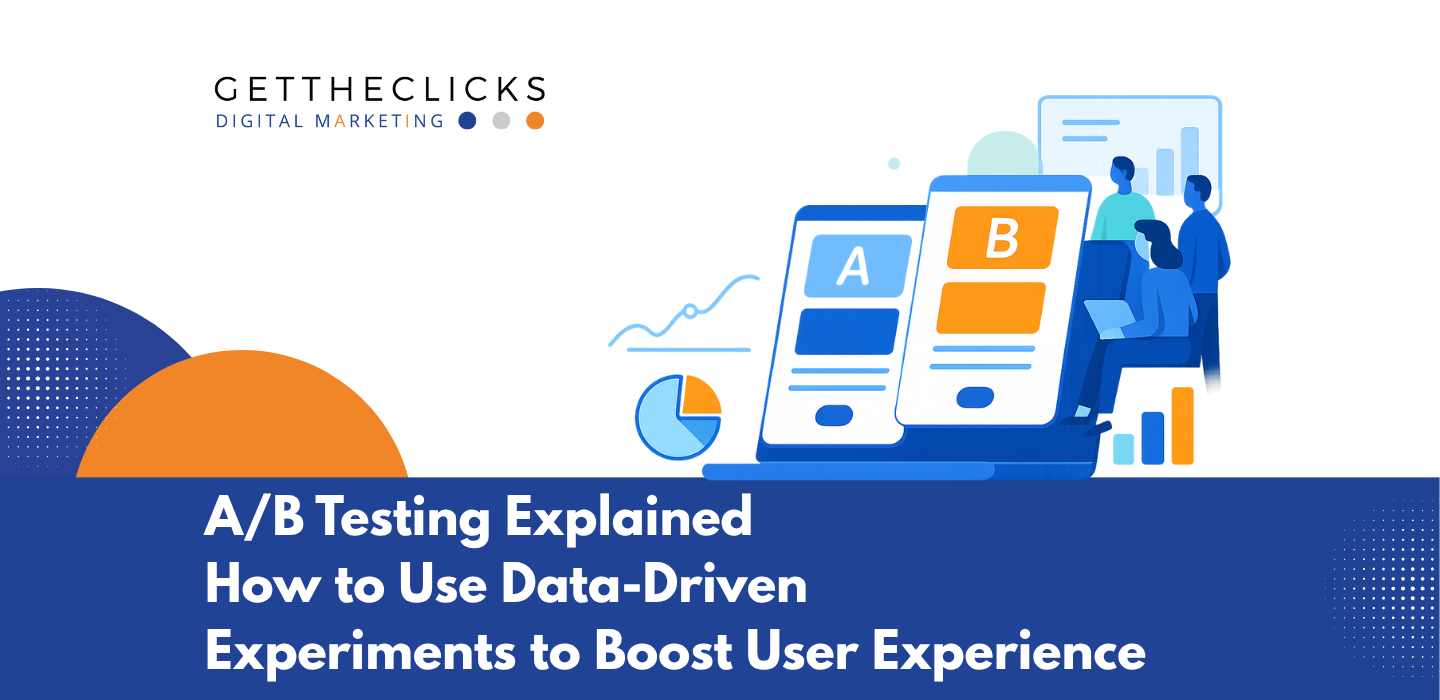
In digital marketing, assumptions can be costly. You might think a headline or button color works better, but without testing, you’re only guessing. A/B testing eliminates that uncertainty by using controlled experiments to identify what actually drives user engagement and conversions in conversion-focused web design.
By comparing two versions of a page or feature, you can see what resonates with your audience and what doesn’t. It’s not about guessing; it’s about learning from real user data to make smarter, evidence-based design and content decisions that measurably improve performance.
What Is A/B Testing and How It Works
A/B testing, also known as split testing, is the process of comparing different versions of a webpage, email, or ad to determine which performs better.
The control (version A) represents the current experience, while the variation (version B) includes a single change, such as a headline, image, or call to action. Visitors are randomly assigned to one of the two, and their actions are tracked against key metrics, such as clicks, sign-ups, or conversions.
While A/B testing isolates one element, multivariate testing examines multiple variables at once to identify interaction effects. Split testing, on the other hand, compares entirely separate URLs. Each method has its use: A/B testing for UX clarity, multivariate testing for complexity, and split testing for major redesigns.
How A/B Testing Improves Website User Experience
A/B testing in digital marketing helps you understand how actual user behavior interacts with your website, uncovering patterns of behavior that go far beyond what analytics alone can reveal. By testing variations, you replace guesswork with data-driven decisions that directly enhance usability and engagement.
- Reveals User Behavior Patterns – B testing shows how visitors actually respond to changes in layout, design, and messaging, helping you identify what truly drives engagement.
- Validates Design and Content Decisions – Instead of relying on assumptions, each experiment confirms whether a specific change improves user experience and conversion rates.
- Optimizes Key Interaction Points – Testing elements like call-to-action buttons, forms, and navigation menus ensures smoother user journeys and fewer friction points across your site.
- Improves Clarity and Communication – Understanding A/B Testing is knowing the need to experiment with headlines, CTAs, and visuals, till you discover which test variations communicate your message most effectively to your audience.
- Builds a Continuous Improvement Cycle – Insights gained from each test inform future design choices, creating a sustainable, data-driven optimization approach that enhances user experience.
How to Plan an Effective A/B Test
A successful test starts with a clear hypothesis, testing one that predicts an outcome you can measure. For example, changing the CTA color from blue to orange will increase conversions by 10%.
Define your primary metric (like conversion rate) and other metrics (like bounce rate or time on page) to get a complete view of performance.
User segmentation ensures accuracy. Different audiences behave differently, such as mobile users, new visitors, or those from specific geographic regions.
External factors, such as seasonality or promotions, can also skew test data. Planning carefully and defining variables up front ensures the insights you gain are valid and actionable.
Best Practices for Running A/B Tests Accurately
A/B testing best practices require structure, patience, and precision to ensure that your test results are reliable and actionable. Following a few core practices helps you minimize bias and gather insights that truly reflect user preferences.
- Choose the Right Testing Method – Decide between client-side and server-side testing based on your goals; client-side offers flexibility for front-end changes, while server-side delivers faster, more accurate results for complex sites.
- Run Tests for an Adequate Duration – Allow your tests to run through complete business cycles to capture natural user research variations and avoid misleading short-term data.
- Distribute Traffic Evenly and Randomly – Ensure that visitors are evenly split between variations to maintain unbiased comparisons and statistically significant outcomes.
- Avoid Cross-Test Contamination – Don’t run testing on multiple elements targeting the same audience or overlapping features, as this can distort metrics and produce unreliable insights.
- Monitor Performance Throughout the Test – Track progress to identify technical issues, uneven data, or anomalies that could compromise the integrity of your results.
Understanding A/B Test Results With Statistical Significance
Reaching statistical significance means that your results are unlikely to be due to chance. It’s your signal that the variation truly performs differently.
Two key concepts define this: statistical tests, such as p-values, which measure the probability that results are random, and confidence intervals, which estimate the likely range of impact.
Most statistical analyses target a p-value of less than 0.05 and a 95% confidence level. This ensures that your findings are credible, not accidental. However, don’t rush to declare winners. Allow enough data to accumulate to avoid false positives or misleading short-term fluctuations.
Advanced A/B Testing Strategies for Better Insights
As your testing program matures, advanced strategies help you move beyond basic comparisons to gain deeper, more valuable insights. These methods allow you to test smarter, analyze faster, and optimize experiences across entire user journeys.
- Use Sequential Testing for Ongoing Analysis – Sequential testing lets you review results at set intervals, enabling quicker decision-making without waiting for a fixed sample size.
- Apply Bayesian Analysis for Dynamic Insights – Bayesian methods continuously update probabilities as data arrive, offering faster and more flexible interpretations of test outcomes.
- Expand Testing Across the Full User Journey – Move beyond web page tests to evaluate entire flows, such as onboarding, checkout, or subscription paths, for a more holistic understanding of user behavior.
- Ensure Consistency Across Devices and Platforms – Test on mobile, desktop, and tablet to guarantee that improvements work seamlessly across all user environments.
- Leverage Machine Learning for Smarter Variations – AI-driven tools can generate and predict high-performing test features automatically, improving accuracy and accelerating the optimization process.
How to Build A/B Testing Into Your Optimization Workflow
To get lasting value, A/B testing examples must be part of your ongoing workflow, not an occasional project. Integrate it into your design, content, and app feature release cycles so testing informs every major decision.
Cross-team collaboration is essential. UX designers, CRO experts, and data analysts should align on test goals and metrics to ensure a cohesive approach to testing.
Treat results as part of a learning system rather than isolated experiments. Over time, this fosters a culture of continuous improvement, where data-driven insights inform every enhancement and drive consistent growth.
Common A/B Testing Mistakes and How to Fix Them
Even well-intentioned A/B tests can fail if they’re not properly structured or managed. Recognizing and avoiding common pitfalls ensures your results remain credible and actionable.
- Skipping a Clear Hypothesis – Always define a specific, measurable prediction before testing; without it, even statistically significant results won’t provide valuable insights.
- Ending Tests Too Early – Resist the urge to stop once results look promising; short tests often produce misleading numerical data that doesn’t hold up over time.
- Running Overlapping or Conflicting Tests – Avoid testing process conflicts by ensuring distinct variables; overlapping audiences can distort outcomes and make interpretation difficult.
- Ignoring External Variables – Existing data may be skewed by factors such as seasonality, ad campaigns, or technical bugs; therefore, it is essential to control for these to maintain accuracy.
- Failing to Document and Review Past Tests – Keep detailed records of each testing strategy to prevent redundancies and build a data-rich archive of lessons learned.
Top Tools for Running A/B Tests Effectively
Leading platforms, such as Optimizely, VWO, Adobe Target, and Convert, as well as split testing software like Google Optimize 360, make it easier to design, run, and analyze experiments.
Each has unique strengths: Optimizely supports testing tool server-side functionality for large organizations, while VWO offers an intuitive interface ideal for mid-sized businesses. Select your tool based on the level of traffic, development capacity, and integration requirements.
The best platforms seamlessly connect with analytics tools like Google Analytics, Mixpanel, or Segment, providing a unified view of test effectiveness and performance across all channels.
What to Do After an A/B Test Ends
Once your test concludes, don’t focus only on the “winner.” Look deeper by asking, did the result affect session length, click-through rate, or customer lifetime value? A winning variation isn’t always the right long-term choice if it harms other indicators.
Use the insights gained to inform future experiments. Implement successful changes, record findings, and plan next steps. Even losing variants are helpful; they tell you what not to pursue.
Over time, your insights create a roadmap of the minimum detectable effect for landing pages, product descriptions, and more, far stronger than any highest-paid person’s opinion.
Turn Your Data Into Real Conversions With Get the Clicks
Ready to transform insights into measurable growth? At Get the Clicks, we help businesses harness the power of A/B testing and data-driven optimization to boost engagement and revenue. Start testing smarter today because every click should move your business forward.