Choosing the proper Google Ads match type often feels more complex than it should. You are encouraged to trust automation, yet warned about wasted spend. Some experts argue that an exact match is safer, while others claim it limits growth.
The truth is that neither option is inherently better. With expert Google Ads management services, you understand how broad match and exact match actually work in today’s intent-driven Google Ads campaigns, enabling smarter decisions that balance reach, relevance, and performance without guesswork.
Understanding Google Ads Match Types
Choosing the right keyword match types can feel confusing because you are balancing automation with control.
Exact match is often seen as safer, while broad match is viewed as risky, yet both are strategic tools when used correctly. Keyword match types determine how closely a user’s search query must align with your keyword.
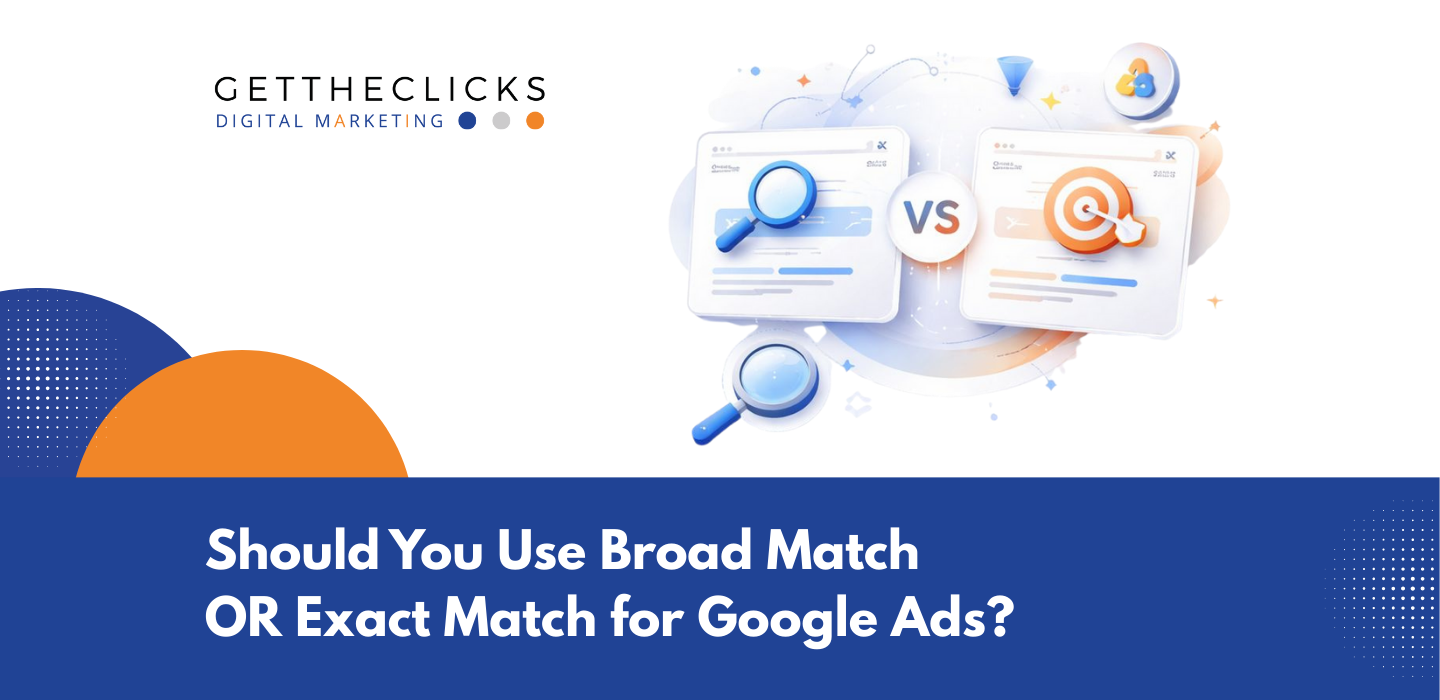
Broad match allows ads to show for relevant searches related in meaning, even if the wording differs. Exact match triggers ads when search intent closely matches your keyword. Today, Google relies on context, behavior, and intent rather than exact words.
Key Differences Between Broad Match and Exact Match
Broad match and exact match approach keyword targeting in very different ways, and the impact of each becomes clearer when you compare them directly. Each difference affects how much reach, control, and efficiency you gain from your search campaigns and explains why your Google ads aren’t converting. The two differ in:
- Reach and visibility: Broad keywords expand reach by showing ads for searches are related in meaning, even when the wording is different. Exact match limits visibility to specific user searches that closely align with your chosen keyword phrase, prioritizing relevance over scale.
- Learning and optimization: Broad match feeds Google more data by exposing it to a wider range of auctions, which helps Google’s machine learning identify new, converting patterns over time. Exact match produces cleaner and more focused data, making performance easier to analyze but slower to scale.
- Control and predictability: Broad match gives Google more freedom to decide which queries match, which can feel less predictable without strong signals. Exact match offers tighter control over ad spend and traffic, making outcomes more stable and easier to manage.
- Intent matching: Broad match interprets intent from context, behavior, and historical data, allowing it to capture emerging or indirect demand. Exact match targets clearly defined user intent, ensuring ads appear when users search with strong purchase or action signals.
- Flexibility and structure: Broad match works best in automated, data-rich accounts that can tolerate testing and fluctuation. Exact match performs best in structured campaigns where precision, precise targeting, and efficiency are the top priorities.
When Broad Match Makes Sense
Using broad match keywords makes the most sense when your campaigns are focused on discovery, learning, and growth.
It is especially useful when launching new products, expanding into new markets, or testing demand, because it surfaces search terms you may not anticipate.
Using broad match performs best with strong conversion tracking, allowing Google to learn which search queries matter most. When paired with smart bidding, bids adjust based on conversion likelihood instead of fixed rules.
Broad match type does not automatically waste budget or fail at lead generation. With the right keywords, structure, and data from Google’s keyword matching options, it efficiently captures intent-driven queries.
When Exact Match Is the Better Choice
Exact match is the better choice when strict control over traffic and spend is essential.
In niche, regulated, or high-cost industries, even small amounts of irrelevant traffic can damage performance, making precision critical.
Exact keyword match type targets high-intent searches where messaging closely aligns with user expectations, which is why many B2B campaigns rely on it to avoid early research traffic.
This focus often improves return on ad budget. Exact match is also ideal for manual optimization, offering clearer data, predictable performance, and tighter control when automation feels too risky.
Performance Impacts: Broad vs Exact Match
Performance differences across keyword match types are reflected in engagement and cost metrics.
Exact match usually delivers higher click-through rates because relevance is tightly aligned with intent. This often supports a stronger quality score and predictable performance.
Broad match can generate higher volume and sometimes lower cost per click, but conversion rates vary depending on how well the intent is refined.
Search term overlap can occur when broad and exact match target similar queries. This overlap is not inherently harmful, but it can complicate analysis if not monitored.
Match keyword types also affect data clarity. Exact match provides straightforward attribution and easier reporting. Broad match introduces more variables, requiring deeper analysis.
Neither match type inherently hurts performance. Outcomes depend on how well strategy, structure, and bidding work together.
Choosing the Right Strategy: Factors to Consider
Choosing between broad match and exact match depends on how each one aligns with your goals, budget, and data maturity. Consider these factors when making your decision:
- Campaign goals. Broad match supports awareness and expansion by maximizing reach, while exact and phrase match support performance by targeting high-intent searches.
- Budget and risk tolerance. Broad match spends more aggressively and requires flexibility, whereas phrase and exact match limit exposure to keep costs predictable.
- Account structure and complexity. Broad match works best in data-rich and well-organized accounts, while exact match suits simpler structures with manual control.
- Conversion tracking quality. Broad match relies on strong conversion signals to optimize effectively, while exact match can perform with limited data.
- Impact on the campaign’s performance. Broad match accelerates learning and scale, while exact match prioritizes efficiency and spend control.
How Google’s Machine Learning Affects Match Type Effectiveness
Google Ads has shifted toward intent-based matching powered by Google’s machine learning. Even exact match now considers meaning rather than exact words. This change makes keyword matches less rigid but more adaptive to behavior.
Responsive Search Ads and audience signals give Google additional context to refine delivery. When paired with smart bidding strategy, broad match often performs better because bids adjust dynamically based on conversion probability. Manual bidding limits this adaptability.
Many advertisers wonder if exact match has changed or if AI overrides match types. Exact match still matters, but it acts as a strong signal rather than a strict boundary.
Understanding keyword match types helps you choose the right keyword match types that align with modern optimization.
Best Practices for Testing and Optimizing Match Types
Optimizing keyword match types requires structured testing and consistent monitoring so performance insights remain clear and actionable. Hee are some of the best spractices we recommend when testing match types:
- Ad group level separation. Testing broad and exact match in separate ad groups prevents keyword overlap and allows cleaner performance comparisons.
- Use of negative keyword match types. Adding negative keywords is critical for controlling intent, especially with broad match, to block irrelevant queries.
- Search term report monitoring. Regularly reviewing reports shows how Google matches queries and where targeting needs refinement.
- Segmented performance analysis. Segmenting reports by match type helps you identify trends in cost, conversions, and engagement.
- Ongoing optimization mindset. Clear data allows you to shift from reactive fixes to proactive improvements that strengthen long-term results.
Final Recommendations: Strategic Use of Match Types
Hybrid strategies are no longer optional. Using broad match for discovery and exact match for performance allows you to target different ad groups and funnel stages effectively. Broad match fuels growth and learning, while exact match anchors efficiency and same intent targeting.
Avoid relying entirely on automation without direction. Keyword research and thoughtful keyword targeting remain essential. Match types remain strategic levers that should align with business goals and campaign objectives.
When used thoughtfully, they transform from a source of confusion into a competitive advantage by capturing related searches, excluding unwanted ones, and surfacing the relevant keywords.
Get the Clicks Helps You Turn Match Type Strategy Into Real Growth
At Get the Clicks, you do not guess which match type works best for your business. You get a data driven Google Ads strategy built around your goals, your budget, and real user intent. Contact us If you are ready to turn broad and exact match into predictable performance.