If you manage service area pages, you have likely seen rankings fluctuate without a clear reason. Thin content pages remain a major cause. Even in 2026, search engines still evaluate whether your pages provide real value or simply repeat the same message across multiple locations.
Many issues become visible when reviewing data in Google Search Console, especially when thin content or duplicate content patterns appear across multiple pages.
When your pages fail to answer real user needs, you lose visibility and leads. This doesn’t improve visibility in local search results and often results in a thin content penalty, reduced SEO performance, and declining organic traffic.
To fix this, you need to focus on identifying thin content, understanding how search engines judge usefulness, how users behave, and how to fix thin content by building pages that solve specific problems in each location.
What qualifies as “thin content” in 2026?
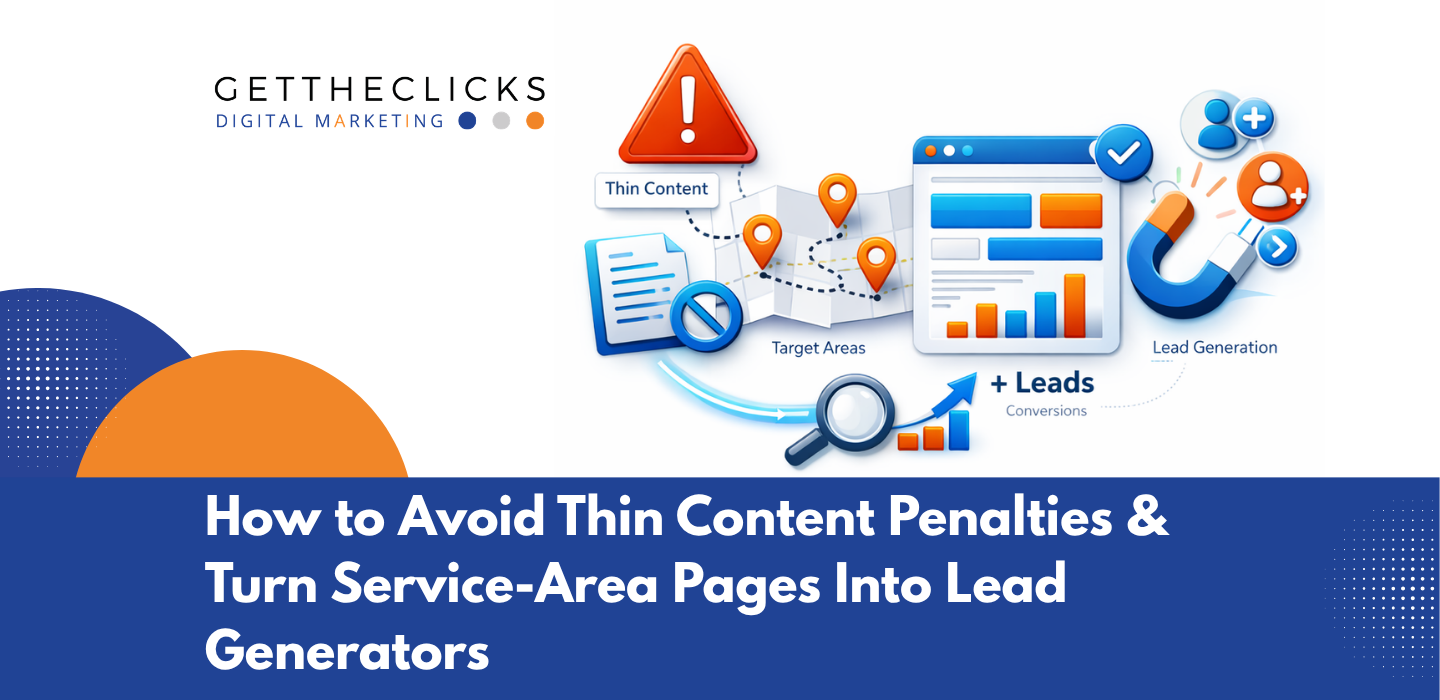
Thin content refers to more than just a low word count. It includes low-quality content, automatically generated content, or low-value content that fails to satisfy search or user intent. If your page content repeats generic service descriptions without local relevance, search engines may classify it as low-value.
Service area pages are especially vulnerable because many businesses reuse the same template and swap city names. This creates similar or duplicate content at scale across a website’s pages. Such pages may even resemble doorway pages, which Google considers a violation of its guidelines.
The shift is clear. Location swapping no longer works. You must present real experience, local knowledge, and a unique context. Search engines now measure usefulness by how well your page answers the user’s search intent, not by how many target or primary keywords you include.
Overusing tactics like keyword stuffing can trigger issues with the Google algorithm and hurt your website’s SEO performance.
What Triggers Thin Content on Service-Area Pages
When your content structure, phrasing, and examples stay the same across locations, search engines detect duplication quickly, especially across category pages, product pages, or affiliate pages. This is where developing user personas for better UX design becomes essential, ensuring each page reflects real user needs.
There is no fixed percentage for duplicate content, but patterns matter. If most of your page remains unchanged except for location names, it signals low effort and may resemble thin or low-quality affiliate content.
Intent mismatch is another trigger. If your page targets “plumber in Tampa” but only provides generic service details without addressing local issues, it fails to meet the user’s needs. Low engagement then reinforces this.
If users leave quickly, do not scroll, or fail to contact you, search engines interpret that as poor user experience. Pages overloaded with too many ads, weak meta descriptions, or even broken links further contribute to low-quality pages.
Mapping Real Search Intent for Each Service Area
To build stronger pages, you need to understand what users actually want in each location. This is where many websites fall short, especially on e-commerce sites and local businesses managing multiple websites or large-scale structures.
Focus on aligning your content with real search behavior:
- Identify what users are trying to solve in each location
- Recognize how search intent varies from place to place
- Account for regional differences like climate, property type, and urgency
- Distinguish between high-intent searches and research-driven searches
- Address pricing, availability, and service comparisons clearly
- Build a content strategy that aligns with user intent and decision-making
Search intent shapes how users interact with search engine results. When your content reflects these differences, your pages become more relevant, more useful, and more likely to convert.
Structuring Service-Area Pages to Deliver Unique Value
A strong service-area page follows a clear structure, but the content inside that structure must be specific to the location.
You should start with the problem. What happens in that area that makes your service necessary? This immediately shows relevance and supports search engine optimization, while also helping with fixing thin content by making each page more specific.
From there, explain how you handle that situation. Be clear about your process, your approach, and what the user can expect. Avoid copying from other websites or relying on generic templates.
Generic introductions weaken your authority because they do not connect to real conditions. Users recognize this quickly. They want to see that you understand their environment.
Before someone contacts you, they are looking for clarity. They want to know timelines, pricing expectations, and what happens next. When you provide this information directly, you create valuable content, improve content quality, and deliver in-depth information that drives results.
Turning Location Pages Into Lead Generators
Ranking is only part of the equation. A page needs to convert visitors into inquiries. This applies whether it is a sales page, about page, or blog post supporting your main services.
This starts with trust. Users want to know they are making the right decision. Clear proof helps with this. When you present measurable results, explain your process, and show how your work connects to outcomes, you reduce hesitation.
You should also make the next step obvious. A clear call to action, visible contact options, and simple forms reduce friction.
Content presentation plays a role as well. Short, direct explanations keep users engaged and create a positive user experience. If they can quickly understand what you offer and how it applies to them, they are more likely to reach out, which improves SEO rankings and search traffic.
Demonstrating Experience and Local Relevance at Scale
To stand out, you need to demonstrate real experience in each area you serve. This goes beyond listing cities and helps you avoid thin content issues that weaken performance.
Focus on showing depth and local relevance:
- Include examples of work completed in that specific location
- Highlight common issues you regularly handle in the area
- Share insights gained from real customer interactions
- Explain local conditions, timelines, and service challenges
- Write quality content in your own words to avoid generic duplication
Users look for clear signals that you understand their situation. When your content reflects real experience, it builds trust and improves relevance.
Surface-level localization does not work. It feels generic and disconnected. Detailed, experience-driven content is what separates strong service-area pages from low-value ones.
Using Customer Questions to Eliminate Thin Content
One of the most effective ways to improve your content is to listen to your customers.
Before hiring, people ask similar questions. They want to know about pricing, timelines, risks, and results. These questions should shape your pages and your broader blog content.
Sales calls, support conversations, and emails provide direct insight into what users care about. When you turn these into content, you address real concerns and improve relevance.
FAQs should not exist just to fill space. Each answer should help the user move closer to a decision. When structured properly, this section becomes one of the most valuable parts of your page and supports better internal linking opportunities across related topics.
Creating Content That Competitors Can’t Easily Replicate
If your content looks like everyone else’s, it will perform like everyone else’s.
Unique value comes from original insight. This includes your process, your data, and your experience. Writing quality matters, but it is not enough on its own. Depth comes from substance, not style.
Each page should function independently. If someone lands there without visiting any other part of your site, they should still understand what you offer and how to proceed. This reduces reliance on excessive pages and helps preserve your crawl budget.
Avoid risky tactics such as link schemes, over-reliance on automation, or publishing content solely for volume. These practices can lead to Google penalties.
Internal Linking and Topical Authority for Service Areas
When you think about service-area pages, it is easy to treat them as isolated assets. In reality, they should work together as part of a connected system. Search engines evaluate how your content connects across your site.
Focus on building clear pathways:
- Link location pages to core services, case studies, and contact actions
- Connect each page to relevant nearby service areas and supporting content
- Avoid isolated pages that lack context and weaken site structure
- Use natural anchor text that reflects real user language
- Guide users toward the next step without confusion
When pages connect properly, search engines better understand your coverage, and users move through your site with ease. Strong internal linking does more than support visibility. It helps users find answers faster and increases the likelihood they contact you.
Avoiding Common Scaling Mistakes
It can feel tempting to publish dozens or even hundreds of service-area pages in one push. On the surface, it looks like growth. In practice, it often creates a quality problem that is difficult to fix later.
When you scale too quickly, you sacrifice depth. Pages start to repeat themselves. Local insights disappear. The content becomes predictable, and search engines pick up on that pattern almost immediately.
A better approach is to start with your highest impact locations. Focus on areas with strong demand and where you can clearly explain local problems and solutions. Build those pages with care, then expand outward.
You also need to honestly review performance. If a page attracts traffic but does not generate inquiries, it likely misses the mark. That does not mean you should delete it immediately, but it does mean you should revisit the content and improve it.
In some cases, fewer pages deliver stronger results. A smaller set of well-developed pages often outperforms a large set of thin ones. The goal is not volume. The goal is relevance and clarity.
Measuring Success Beyond Rankings
It is easy to look at rankings and assume success. A page appears in search results, traffic increases, and everything seems to be working. But rankings alone do not tell you whether your content actually performs.
What matters is how users behave once they land on your page. Do they read the content? Do they scroll? Do they take action?
You should pay close attention to engagement signals. Time on page, click behavior, and contact form submissions provide a clearer picture of value. If users arrive and leave quickly, your page likely fails to meet their expectations.
The most important signal is conversion. A service-area page should help generate leads. If it does not, something is missing. That could be unclear messaging, a lack of trust signals, or content that does not address real concerns.
You also want to identify underperforming pages early. Compare traffic to results. If a page receives visits but produces no inquiries, it needs attention. Continuous improvement means reviewing, adjusting, and refining your content over time.
Future-Proofing Service-Area Pages Against Algorithm Updates
Search engines continue to refine how they evaluate content, but the direction is consistent. They prioritize pages that provide clear, helpful, and experience-based information.
This means your content needs to reflect how you actually work. You cannot rely on surface-level descriptions or generic claims. You need to show your process, explain your decisions, and demonstrate your understanding of real problems.
There is also a noticeable shift toward experience-driven content. Users want to know what happens when they hire you. They want details, not general statements.
At the same time, AI-generated content is becoming more common. This increases competition, but it also creates an opportunity. Many of these pages lack depth and real-world insight. If you include genuine knowledge from your work, your content stands apart.
The safest long-term approach is simple. Focus on clarity, accuracy, and usefulness. When your pages consistently answer real questions and guide users toward decisions, they remain stable even as algorithms change.
Get The Clicks Builds Pages That Generate Real Leads
We analyze your service areas, write content that answers real customer questions, and structure every page to drive calls, not just clicks. We measure performance, refine what works, and remove what does not. If you want pages that produce consistent leads, schedule your consultation; we are ready to build them with you.