Introduction
Every day, it seems like our world becomes more and more fast paced. Innovation has gone from an infrequent occurrence to a constant reality, and whether we like it or not, artificial intelligence has come to the forefront. Specifically, generative AI has become extraordinarily relevant, and today, I’m going to illuminate you on what they are, the pros and cons of each, how they might be able to help your business thrive, and how they can cause you harm, with specific sections along the way highlighting the crucial importance of AI agents in this new frontier.
Defining AI
Firstly, you need to understand what I mean when I say AI. AI is a term that’s thrown around a lot nowadays, as if it’s a new thing. However, artificial intelligence is actually something that first began to be developed all the way back in the late 80s, in the form of algorithms meant to replicate the human ability to solve puzzles, or make logical deductions, with step-by-step reasoning. AI by its true definition covers a very broad spectrum, all of which are based around one key principle: The replication of human intelligence. Artificial Intelligence is categorized by capability into Narrow AI, General AI, and Superintelligence, and by function into Reactive, Limited Memory, Theory of Mind, and Self-Aware. Narrow AI (also called Weak AI) is the dominant form today, being task-specific and exemplified by systems like Siri, Alexa, and self-driving cars. Reactive Machines are basic AI that respond to stimuli without memory, while Limited Memory AI uses past data for future decisions. Of course, the human brain has a variety of diverse and complex functions, naturally causing AI to cover a variety of diverse and complex topics.
Nowadays, however, when people refer to the term “AI”, they usually are referring to “generative AI.” This form of AI transcends the abilities of previous AIs in that it is far more autonomous than the AI that has come before it. It creates new, original content such as images, text, music, and code by learning patterns from massive datasets. This is most often done in response to a prompt from a human, and by combining data from previous human inputs/responses with data from its data set, it will mimic human creativity/intelligence to “generate” whatever was requested of it.
Generative AI takes many different forms, but in this article, we’re going to be analyzing three different types: AI chatbots, AI assistants, and AI agents.
Chatbots, Assistants, and Agents
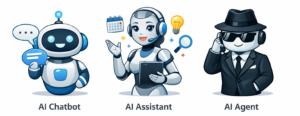
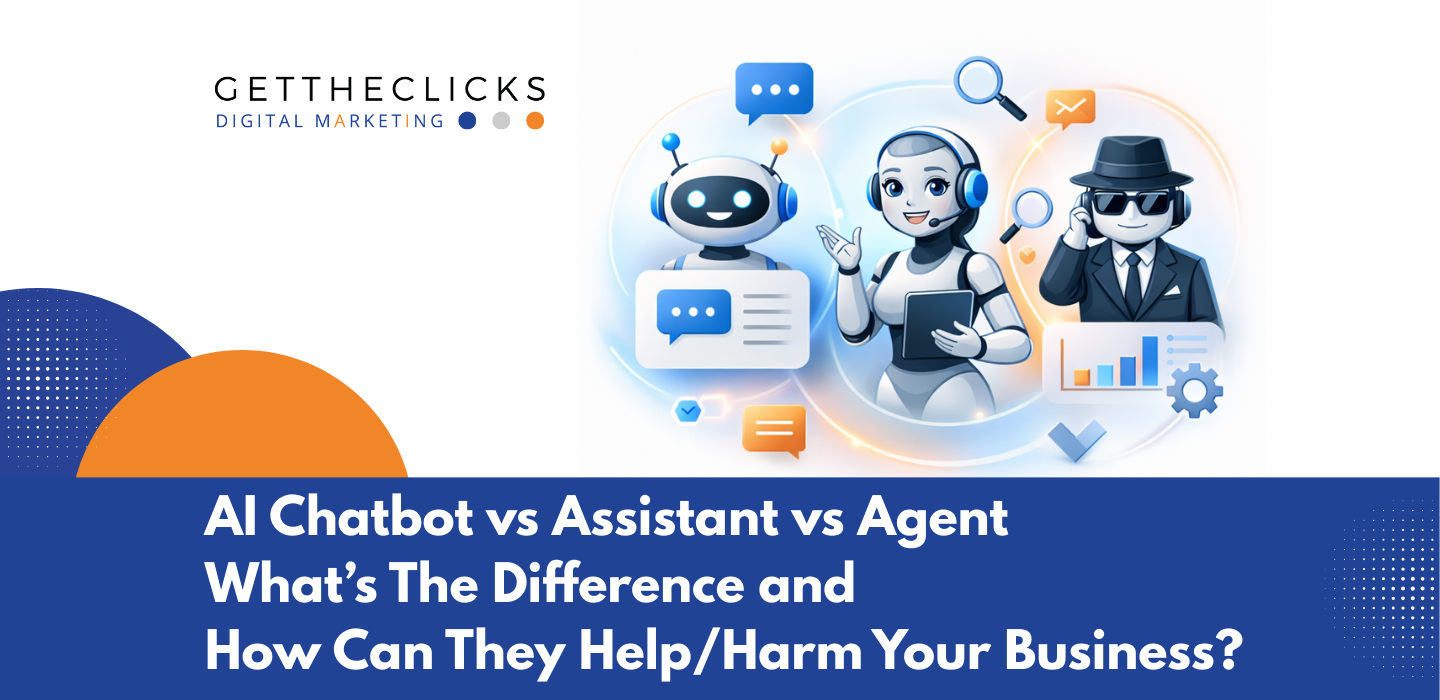
- AI Chatbot: This is an AI primarily designed for conversation. Its primary functions include answering questions, explaining things, writing text, and holding dialogue. AI chatbots can also write stories and generate creative content, demonstrating their storytelling capabilities.
- AI Assistant: This is an AI primarily designed for helping you complete tasks. Its primary functions include supporting workflows in the form of summarizing text, creating documents, scheduling, searching, coordinating steps, and so on.
- AI Agent: This is an AI primarily designed to pursue a given goal over time. Its primary function is the pursuit of said given goal, through a loop of planning, acting, observing results, and then adjusting. In technical terms, an AI agent is a type of intelligent agent, an autonomous AI system capable of perceiving its environment, making decisions, and taking actions to achieve specific objectives. AI agents can collect data from external systems and tools via APIs (application programming interfaces) to perceive their environment. When describing how AI agents work, it’s important to note that their architecture typically includes modules for perception, decision-making, and action, enabling them to autonomously handle tasks such as code review, testing, and security vulnerability detection. They can also take initiative based on forecasts and models of future states. Agents work by making decisions, collaborating with other agents or systems, and playing a key role in AI-driven software development workflows. Because of how crucial they are in recent developments for business, we’ll be focusing on them a lot in this article, so make sure you’re strapped in for that.
How AI Agents Work
The workflow of an AI agent typically starts with a specific goal or task. The agent then plans its approach, executes actions, and adapts its strategy based on real-time feedback and changing conditions. This cycle of planning, acting, observing, and learning allows AI agents to continuously improve their performance and make informed decisions.
Unlike simple reflex agents, which only react to immediate inputs using predefined rules, other AI agents, such as model-based reflex agents, maintain an internal model of the world. This internal model enables them to consider past actions, predict future states, and adapt their behavior accordingly. For example, a model-based reflex agent in supply chain management might analyze historical data to forecast demand and adjust inventory levels proactively.
AI agents leverage machine learning techniques to identify patterns in data, learn from past interactions, and refine their decision making over time. This means that as agents work, they become better at handling both routine and complex tasks, automating processes that once required significant human oversight. Whether operating independently or as part of a larger multi-agent system, AI agents can collaborate with other agents and components, further enhancing their ability to tackle complex workflows and deliver value to businesses.
By integrating artificial intelligence and machine learning into their core, AI agents are able to perform tasks autonomously, adapt to dynamic environments, and support organizations in automating everything from simple customer queries to intricate business processes.
Key Features of AI Agents
AI agents are rapidly becoming the backbone of modern business automation, thanks to a set of powerful features that set them apart from traditional software and even other forms of artificial intelligence. Understanding these features is essential for any organization looking to streamline operations, tackle complex tasks, and stay ahead in a competitive market, hence AI agents getting their own dedicated section.
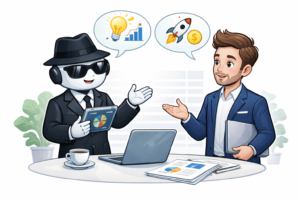
Autonomy is at the heart of what makes AI agents so valuable. Unlike simple reflex agents that only react to immediate inputs, autonomous AI agents can make decisions and take actions independently, without constant human supervision. This means they can handle routine tasks, like sorting customer data, managing inventory, or monitoring infrastructure. This frees up your team to focus on more strategic, creative work.
Goal-oriented behavior is another defining trait. AI agents are designed to pursue specific objectives, whether that’s optimizing delivery routes, maximizing sales conversions, or improving customer satisfaction. They use a utility function or performance metric to prioritize actions, allocate resources, and adapt their strategies as circumstances change. This makes them ideal for automating complex workflows and ensuring business processes stay aligned with your goals.
- Perception allows AI agents to interact with their environment, whether that’s through APIs, sensors, or direct data feeds. By continuously gathering information, they can update their internal model, identify patterns, and make informed decisions. For example, in financial trading, an AI agent might monitor market trends in real time, adjusting its strategy based on new data.
- Rationality is what enables AI agents to make smart choices. By combining machine learning techniques, domain knowledge, and reasoning, they can weigh options, predict outcomes, and select the best course of action. This is especially useful for businesses looking to automate complex decision making, from treatment planning in healthcare to code generation in software development.
- Proactivity sets advanced AI agents apart from reactive systems. Rather than waiting for instructions, they anticipate future states and act accordingly, proactively identifying potential issues, mitigating risks, or seizing new opportunities. For instance, an AI agent might spot a security vulnerability in your software applications before it becomes a problem, helping you maintain a strong security posture.
- Continuous learning is crucial in today’s fast-changing environments. AI agents learn from past interactions, chat history, and feedback mechanisms, constantly refining their behavior to improve performance. This means they get better over time at handling user requests, automating repetitive tasks, and adapting to new challenges.
- Adaptability ensures that AI agents remain effective even when faced with uncertainty or incomplete information. They can adjust their strategies on the fly, making them resilient in dynamic environments, whether that’s responding to sudden changes in customer demand or navigating supply chain disruptions.
- Collaboration is increasingly important as businesses deploy multiple AI agents across different functions. These agents can communicate, coordinate, and cooperate with each other, as well as with human agents and external systems. In multi-agent systems, this collaboration enables organizations to tackle complex tasks that would be impossible for a single agent or human to manage alone.
Types of AI Agents
AI agents come in various forms, each suited to different business needs. Simple reflex agents handle straightforward, rule-based tasks, while model-based reflex agents use an internal model to make more informed decisions. Goal-based agents and utility-based agents focus on achieving specific outcomes, and learning agents continuously improve through experience. By deploying the right mix of agent types, businesses can automate routine tasks, manage complex workflows, and achieve significant cost savings.

The real power of AI agents emerges when they are integrated with other AI systems and technologies. For example, combining AI agents with large language models and natural language processing enables the creation of AI chat systems that deliver personalized customer experiences. These systems can understand and respond to user requests in natural language, drawing on customer data and past interactions to provide relevant, timely support. By connecting with external tools and other components, AI agents can offer even more comprehensive solutions, whether that’s automating code generation, analyzing data, or improving the performance of other AI models.
Deploying multiple AI agents as part of a multi-agent system allows organizations to scale their operations, increase flexibility, and build resilience. These systems can handle complex, interdependent tasks, share knowledge, and adapt to changing business needs, making them a cornerstone of modern, AI-driven enterprises.
As artificial intelligence and agent technology continue to evolve, the role of AI agents in business will only grow. From automating repetitive tasks to enabling informed decisions and driving innovation, AI agents are poised to revolutionize business processes across industries. By understanding and leveraging their key features, organizations can improve efficiency, enhance decision-making, and gain a lasting competitive edge in an increasingly digital world.
General Pros and Cons of Each Generative AI Type: Chatbots
Let’s start with the simplest form of generative AI, the AI chatbot. Chatbots are primarily useful for their ability to provide information. If you ask a chatbot a question, it responds with information based on the response it deems to be the most likely to be accurate. Already, one can notice an issue here, in that the information a chatbot provides may not be on brand, or accurate. Chatbot sites will even have frequent disclaimers stating that the information given by their bots may not be true. While already an issue of concern here, the lack of autonomy AI chatbots have means that misinformation can at least be somewhat contained, assuming the human user on the other end understands the situation that they are in, though a misinformed human who hurts themselves because of misinformation from your chatbot could have reason to take you to court. Another issue is that getting a chatbot to stick to behavior relating to your brand can remain tricky. Of course, this lack of autonomy also means that chatbots can’t really do much in terms of providing assistance, and while they have become a lot better at providing accurate information, there are still many examples of misinformation being spread by AI chatbots. The only way to truly confirm if something is true is through personal, dedicated research.
Pros and Cons of Assistants

Things immediately begin to get more complicated when we begin discussing AI assistants. You can already see a massive increase in autonomy here, in that these AIs can perform simple tasks for you. The usefulness of this is obvious, in that you can get more done more efficiently. AI agents automate repetitive tasks, allowing humans to focus on more creative work. However, the downside is that you are not only relying on an AI which can get information wrong, you are now also relying on it completing a task in the way you wanted, which an AI can fail at. For example, when summarizing an important email, it will focus on the information it deems the most likely to be important to you. This could mean potentially missing out on a key detail you otherwise would’ve caught had you simply read the email yourself. Since these assistants can be deceptively reliable, it also means errors are more likely to go unchecked.
Pros and Cons of Agents

The AI agent takes the previously mentioned pros and cons even further. Efficiency becomes easier than ever, as entire tasks can be delegated to a single AI that will work faster than any human. AI agents can operate independently without the need for human intervention, making them highly autonomous. However, this increased autonomy also means that oversight is still important to ensure responsible and effective outcomes. Of course, again, the fallibility of generative AI, along with the AI’s inability to perfectly replicate what you may have wanted, means that the assigned task may not be completed properly. The more complex you make said task, the more likely it is that these cons will begin to show. Give the agent enough power and it could even kill your entire company (perhaps it felt the most efficient way to handle the prompt of “make sure none of my customers feel dissatisfied” is to completely get rid of your customers all together). In essence, the more autonomy an AI has, the more risk there is in using it. The best way to address this is to try to leverage the strengths of both human employees and AI to create a “best of both worlds” scenario. Involving human users for oversight, feedback, and control is essential to ensure that AI agents are used responsibly and effectively.
So far, the primary focus of this article has been on what these types of AI are, and their distinctions/differences. It should be clear by now that, while generative AI has become quite advanced, it still has quite the distance to go before it will completely replace humans. Now, we’re going to dive deeper into how these differences affect their usefulness for your business.
How Generative AI is Similar to an Employee
There is an interesting point to be made about each of the forms of AI we’ve listed, in that the very issues listed in regards to them mirror the issues one can have regarding the autonomy one gives to their employees. One of the big topics surrounding AI and its usefulness is its ability to offer a cheap and efficient alternative to human labor. While AI is prone to making mistakes, this is an issue humans can also encounter. The more freedom you give a human employee to complete a task, the more likely it is they may mess it up or not complete the task in the way you would’ve liked. Of course, you can try to counter this by being a helicopter boss, constantly prowling the halls of your office and making sure everyone is focused and working at peak efficiency, but that sort of thing is how you get every single one of your employees to hate you, so a balance between “do exactly what I ask” and “do whatever you want” needs to be found. The key difference between humans and AI though is that AI is in a constant state of evolution and improvement, to the point that it’s likely this article could be outdated within the next year, or even sooner. Every day, AI becomes more and more capable of autonomy without losing out on efficiency or accuracy, while humans are restricted by evolution. There will come a time when, financially speaking, it will make far more sense to employ AI to do work for you instead of humans. This is something in the very near future, so planning for this is already something that should be on the minds of many business owners.
Using AI Today
However, we’re not in the future just yet, so where are we at now? What can AI do that your standard human employee can’t? It all comes down to efficiency. AI can, for example, process large amounts of data far faster than a human can. Let’s say you wanted to adjust your prices on your retail website based on the prices of your competitors, so you tell your human employee to look at each one of your products, compare their price to the same product from a competitor, and then adjust your own price to be lower accordingly. Depending on how many products you sell, this can take a very long time. However, if you can download all of your pricing data onto a CSV file and then feed that to an AI, it would be able to do an online deep dive and generate a new CSV file with adjusted prices in mere minutes. The more products you have to adjust, the more the AI becomes appealing, especially because, unlike a human, AI doesn’t have to deal with problems like mental exhaustion, hunger, the need for bathroom breaks, the need to be paid, and so on.
This doesn’t just apply to CSV files. Any time large amounts of data need to be combed through, AI will simply be able to do it more efficiently than a human. You can even mitigate errors in AI by asking it to double and triple check its work, and it’ll still run circles around a human attempting to do the same task just once. The inability to exhaust AI means it can function 24 hours a day, 7 days a week, without any kinds of breaks for holidays or whatever else. AI chatbots can offer 24/7 support that even a seasoned team of humans couldn’t keep up with. These AI agents can handle customer queries by analyzing data and generating responses, which improves service efficiency and customer satisfaction. Images and videos normally requiring budgeting for filming and editing can now be produced by one good prompter and an AI assistant, or even just an AI agent in a day. Entire simple apps can be coded and put together in hours, and generative AI is only getting faster and more accurate. All that is asked in return is whatever amount of payment is needed to use said AI.
AI agents in particular can proactively identify security threats and vulnerabilities, providing real-time analysis and responses to potential risks. In business, AI agents can automate routine tasks in healthcare, such as analyzing medical data and assisting in diagnosis, optimizing production processes, and predicting maintenance needs in manufacturing. They can help financial institutions detect fraudulent activities and automate transactions, enhancing security by detecting and mitigating threats in real-time. They can personalize learning experiences and automate administrative tasks in education. They can optimize logistics by managing fleet operations and predicting vehicle maintenance. They can even improve customer service through personalized interactions and automation. AI agents can collect data from external systems and tools via APIs to perceive the world around them and recognize changes, further enhancing their effectiveness.
When deploying AI solutions, platforms like Cloud Run abstract away the complexities of infrastructure management, enabling scalable and reliable AI agent deployment. Organizations can deploy AI agents on Cloud Run for scalable, reliable, and flexible deployment, leveraging containerization and serverless infrastructure to handle complex reasoning and multi-agent systems. Google Cloud provides a portfolio of products and solutions in the AI agent space.
AI agents can collaborate with other agents, communicating, coordinating, and sharing responsibilities in multi-agent systems, which is especially valuable in specialized fields like healthcare. By collaborating with each other, AI agents can improve decision-making through shared learning and debate, refining their reasoning through discussion and feedback. They can also learn from their experiences, leading to continuous self-improvement over time. Additionally, AI agents enhance the capabilities of language models by providing autonomy, task automation, and the ability to interact with the real world.
As AI becomes more advanced, it will begin to replace more and more jobs, until the only obvious reason to employ humans will be to prompt AIs to perform tasks. This is the entire selling point behind generative AI, including AI agents, and why so many corporations are dumping billions of dollars into its development.
How Generative AI Can Harm Your Business: A Reality Check
For many of you, reading all of that information might have been exciting, horrifying, or even both. However, especially as a small business, you’ll want to exercise caution when using AI. There are still the flaws mentioned previously, predominantly inaccuracy. A well-trained human can still be more accurate about data crunching than AI, albeit far slower. But what other strengths do human employees bring to the table that AI can’t?
The Importance of Authenticity
The answer is simple. Humans are authentic. A big pet peeve for many people is when they call a company, and have to go through a system of typing in responses with their number pad instead of immediately speaking to someone. AI replicates this feeling. When you realize you’re talking to an AI instead of a person, it often feels like the company you’re interacting with doesn’t really care about you. People want to talk with another human being, especially one who is qualified to provide answers. Studies have shown that humans are generally able to tell AI apart from reality around 60-70% of the time, with the success rate increasing the more time someone has to interact with the AI/person/content in question, so keep this in mind when implementing any kind of AI that’s going to be interacting with customers. A great middle ground to aim for is using both at once, where AI is either used when no human support is available, or as a provider of support that can recognize when it isn’t being of any help, at which point it can then connect the customer to a proper customer service agent (though this second option can still be quite frustrating for a customer to work with). Overall, avoid making your customers interact with AI if they can instead interact with a person.
This authenticity doesn’t just extend to customer service. It applies to content as well. While generative AI is great for creating blogs that hit all the marks for good SEO, a human that recognizes the fact that you just used AI will likely say, “Man, this company is lazy. They’re just feeding me AI slop instead of actual, personalized information.” Again, the solution here is a combination approach. Use AI to collect information such as relevant topics, and optimize your writing for SEO, while using an actual human to write the bulk of the content. If the human writer in question is less capable, depending on the content in question, it may be more ideal to ask AI to generate parts of, or even most of the content, while telling the human to just focus on editing the generated content to seem less like it was written by AI. More skilled human writers on the other hand can use AI less and less as a crutch, which of course will create a more authentic final product.
The creation of images and videos also fall under the same guidelines. In fact, this is where much of the controversy surrounding generative AI stems from. Many of the first jobs being snatched away from people by AI are jobs revolving around the creation of art. Yet AI will often make mistakes that artists don’t, and artists can create a level of customization that AI usually can’t. This, along with the previously mentioned issues of authenticity, all have one thing in common. If your customer is interacting with anything from your company, and realizes AI is being used, there is a high likelihood that they will not be pleased. There is a lot of vitriol surrounding the use of AI, so use it sparingly when it’s public-facing.
Keeping AI Lowkey

With that said, customers don’t really care if you use AI to crunch numbers, or perform otherwise simple and menial tasks. In fact, if you can produce products or services at a quicker rate thanks to the usage of AI, customers will generally not mind, so long as they know that the product or service they are receiving is still one that ultimately had predominantly human hands behind it. A lot of it comes down to a combination of making sure your customers feel like they’re receiving something authentic, and the inherent fallibility of AI.
AI however has one other massive risk tied to it that ought to be addressed more, and that is privacy. Unless the AI you’re using happens to be one you coded and developed entirely yourself, chances are you’ll be using a bot from a major company. Let’s use perhaps the most famous AI as an example, ChatGPT. Let’s say you’re using the ChatGPT Agent to complete work for your company. Any data that ChatGPT combs through will be scraped up into ChatGPT’s own data in order to improve future responses. Any data you give ChatGPT will be placed into its database, and many people don’t even realize this. Every single thing you say to an AI robot is data that is only going to get better at remembering. As conspiratorial as it may sound, imagine what OpenAI could do with all of that sensitive data. Would you trust them with your social security number?
Conclusion
Addressing the topic of business and AI is in it of itself a challenge. The landscape of the topic is in constant flux, and there’s the constant tug of war between speculation, morality, reality, and innovation. More than anything else however, the best advice I can possibly give you is that you need to stay on your toes. Keep moving forward, and never say, “good enough.” Thankfully, you now have a good start. By understanding the importance of how efficient AI is, how AI’s autonomy creates risk, how AI can come across as inauthentic, and how AI creates privacy concerns, you have the baseline level of knowledge needed to put together how exactly AI should be integrated into your business.