
Why AI Feels So Confusing for Small Business Owners Right Now
AI has gone from something you could ignore to something you hear about almost daily. One source says it will replace entire teams. Another says it runs businesses automatically. Others make it sound so technical that only large companies can use it.
The problem is not just the technology. It is the lack of a clear way to think about where AI actually fits in a real business.
Most small business owners are not struggling with whether AI matters. They are struggling with questions like:
- Where would I even use this?
- What can I trust it to do?
- Is this worth my time or just more noise?
Before breaking down the myths, you need a simpler way to understand what AI actually does in day-to-day work.
A Simple Way to Understand What AI Actually Does in a Business
AI is often talked about as if it is one thing. It is not. In practice, it shows up in three very specific ways inside a business.
The Three Ways AI Shows Up in Real Work
Assist
AI helps you do a task faster. The work still depends on you, but the first draft or initial step is accelerated.
Example: drafting an email, outlining a blog post, or writing a job description.
Analyze
AI helps organize, summarize, or interpret information. It reduces the time it takes to understand what is happening.
Example: summarizing customer feedback or turning call notes into key points.
Automate
AI completes part of a repeatable workflow with minimal input once set up.
Example: turning a form submission into a follow-up email or task.
This matters because most confusion about AI comes from treating it like a replacement for people, when it is actually a tool for handling specific types of work.
Every myth below becomes easier to understand once you look at AI through this lens.
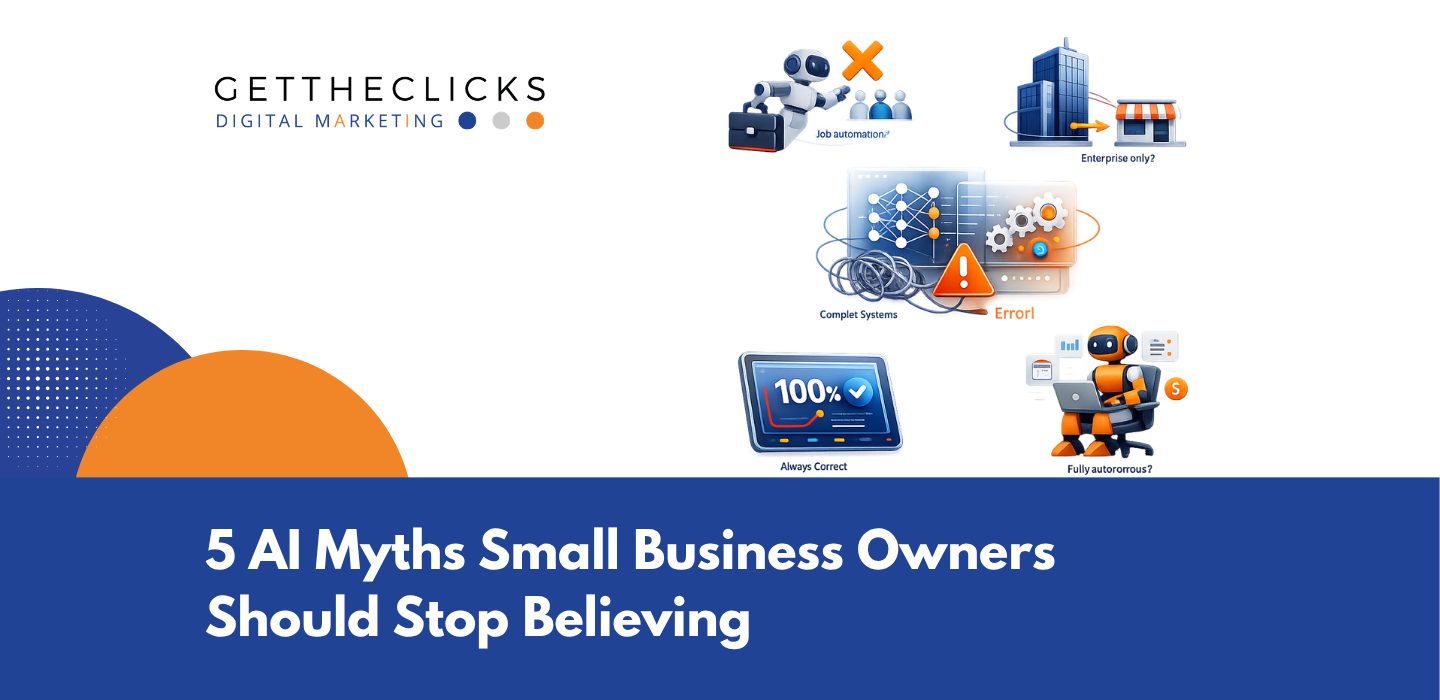
Myth #1: AI Will Replace Jobs
It is easy to believe this because AI can now write, summarize, respond, and generate content quickly. When you see it perform individual tasks well, it feels like it could take over entire roles.
What is actually happening is more specific. Jobs are made up of many different tasks. Some are repeatable and structured. Others require judgment, communication, and accountability. AI tends to perform well on the first type and struggle with the second.
The mistake is thinking in terms of roles instead of tasks. When that happens, business owners either overestimate what AI can do or avoid it entirely.
Through the lens of Assist, Analyze, and Automate, AI fits into parts of a job, not the entire job itself.
The real question is not whether AI replaces jobs.
It is which tasks inside your business are structured enough to be handled more efficiently.
Myth #2: AI Is Only for Big Companies
A lot of AI messaging comes from large companies talking about enterprise tools, large data sets, and complex systems. That creates the impression that AI requires significant investment and infrastructure.
In reality, the cost of AI is tied more to how you use it than the size of your business.
A small business using AI to assist with writing, analyze customer inputs, or automate simple follow-ups is operating on a completely different level than a company building custom AI systems.
The misunderstanding here leads to inaction. Business owners assume they need a large, complex initiative before they can benefit at all.
Viewed through a workflow lens, AI becomes accessible much faster. It can start with something as simple as assisting with repetitive communication or analyzing information you already collect.
The better question is not whether AI is built for big companies.
It is which small, repeatable tasks in your business are already costing you time every day.
Myth #3: AI Is Too Complicated to Use
AI discussions often include technical language like machine learning, APIs, automation frameworks, and agents. For a busy business owner, it can feel like learning a completely new discipline.
The reality is that most business owners do not need to understand how AI is built. They need to understand how it fits into their existing work.
This is where the Assist, Analyze, and Automate model becomes useful again. It simplifies AI into functions instead of technology.
- If a task needs to be done faster, AI can assist
- If information needs to be organized, AI can analyze
- If a process repeats, AI can automate
The complexity usually comes from trying to understand everything at once instead of focusing on one specific use case.
Once you start viewing AI through these three categories, the conversation shifts from “This is complicated” to “Where does this fit?”
The next step is not mastering AI.
It is identifying which of these three functions applies to your current workflows.
Myth #4: AI Always Gets the Right Answer
AI tools often sound confident. They generate clean, well-structured responses quickly. That makes it easy to assume the output is accurate.
But AI does not “know” things in the way people do. It generates responses based on patterns, not verified truth. That means it can be correct, partially correct, or misleading while still sounding convincing.
This matters more as the stakes increase.
If AI is assisting with a rough draft or summarizing notes, errors are easy to catch and fix. If it is influencing pricing decisions, customer communication, or compliance-related information, the risk becomes much higher.
Through the Assist, Analyze, and Automate lens, the key difference is how much impact the output has.
The real challenge is not whether AI is right or wrong.
It is knowing when the output can be used as-is and when it requires careful review.
Myth #5: AI Can Run Your Business for You
Some messaging around AI suggests it can fully automate marketing, sales, operations, and decision-making. For a business owner who is already stretched thin, that idea is appealing.
But AI does not understand your customers, your reputation, your financial constraints, or your long-term goals. It can execute tasks, but it does not set direction.
More importantly, AI depends on the structure of the process it is placed into.
If your workflows are unclear, inconsistent, or undocumented, adding AI does not fix the problem. It often makes it more visible or amplifies it.
For example, automating follow-ups without a clear sales process can lead to inconsistent or confusing communication at scale.
AI works best when it is supporting a process that already makes sense.
The real question is not whether AI can run your business.
It is whether your underlying processes are clear enough to support it.
How Small Businesses Should Actually Think About AI
Across all of these myths, the same pattern shows up.
AI is not a strategy. It is an execution tool.
It helps complete tasks faster, organize information more clearly, and automate repeatable steps. But it does not decide what your business should prioritize or how it should grow.
That responsibility still sits with the business owner.
The most effective way to think about AI is as a layer that sits on top of your existing work. When the work is structured and repeatable, AI can improve speed and consistency. When the work requires judgment or context, it still depends on people.
This is why understanding where AI fits is more important than understanding how it works technically.
Where Most Businesses Should Start (Without Overthinking It)
A practical way to begin is to look for tasks that have three characteristics:
- They happen repeatedly
- They take a noticeable amount of time
- They follow a predictable pattern
These are the situations where AI is most likely to create immediate value.
This could be something like responding to common customer questions, organizing internal notes, or drafting recurring communication. The goal is not to automate everything. It is to improve one clear part of your workflow.
Starting small also makes it easier to understand how AI behaves in your business before expanding its use.
Final Thought: AI Is a Multiplier, Not a Shortcut
AI is not going to replace every job, run your business, or solve every problem on its own. It is also not something small businesses can ignore.
What it does well is improve how work gets done.
If your processes are clear, it can make them faster and more consistent. If your processes are unclear, it can make the problems show up faster.
The businesses that benefit most from AI are not the ones chasing every new tool. They are the ones that understand where AI fits, apply it to the right type of work, and use it to support better decisions over time.