
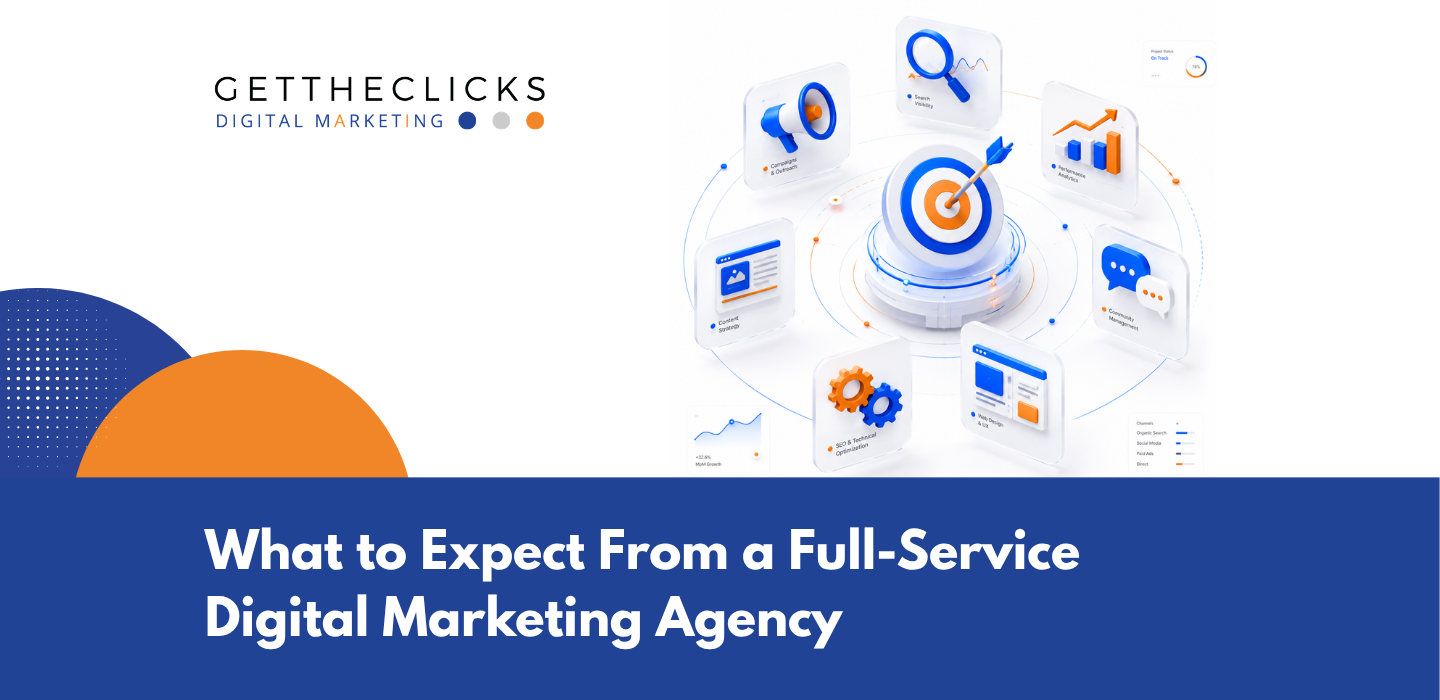
Hiring a full-service digital marketing agency does not mean paying for every available tactic. You should expect a coordinated team from a digital marketing agency in Orlando and beyond to study your business, identify the problems restricting growth, and select the services that address them.
That team should connect strategy, creative work, technology, and measurement around clear commercial goals. You should also receive honest reporting, defined responsibilities, and recommendations supported by evidence.
Understanding these expectations helps you judge whether an agency can provide meaningful support or merely complete disconnected marketing tasks.
What Does a Full-Service Digital Marketing Agency Actually Do?
A full-service digital marketing agency plans, completes, measures, and coordinates the digital work required to support your commercial goals. Its value comes from connecting specialists and information, not from placing the longest possible list of services in your agreement.
Your agency may research customer behavior, plan campaigns, create content, manage advertising, improve your website, and examine performance data. Each activity should address a defined problem. If your website receives qualified visitors but generates few inquiries, conversion work may deserve attention before additional traffic campaigns begin.
Working with one marketing agency can also reduce fragmented decisions. Search specialists can share keyword findings with content writers, advertising managers can report which offers attract serious buyers, and website teams can correct pages that lose valuable prospects.
Full service is not automatically the right model for every company. You may need a specialized provider when one technical issue requires deep expertise. However, when several channels influence the same customer journey, a coordinated digital agency can establish clearer priorities and reduce conflicting work.
How Does a Full-Service Digital Agency Build Your Marketing Strategy?
A full-service digital agency should begin by examining your customers, offer, competition, sales process, current performance, and financial priorities. These findings help the team create an SEO checklist to boost your business based on your actual needs instead of applying a standard package.
Expect the agency to request access to your website, analytics, advertising accounts, search data, CRM, and previous campaign records. Your team should also discuss margins, service areas, seasonality, sales capacity, common objections, and the types of customers you want to attract.
This analysis should identify the constraint that deserves immediate attention. Your company may need more visibility, but it could instead have weak positioning, slow sales follow-up, inaccurate tracking, or a website that discourages inquiries. Sending more traffic into those conditions can increase spending without increasing revenue.
The resulting plan should define priorities, responsibilities, budgets, timelines, and success measures. You should understand why each recommendation appears in the plan and what evidence could change it. A credible agency diagnoses before it prescribes marketing services.
Which Agency Services Should You Expect to Receive?
You should receive the agency services required by your approved strategy, not every capability the company offers. A wide range of services provides flexibility, but launching all channels at once can divide your budget and prevent the team from completing foundational work properly.
Depending on your goals, a full-service marketing agency may recommend:
- Search engine optimization (SEO): Strengthens technical quality, search relevance, local visibility, content depth, and authority.
- Paid advertising: Captures existing demand through search platforms or reaches defined audiences through social campaigns.
- Website and conversion work: Improves navigation, page clarity, forms, calls to action, and the path from interest to inquiry.
- Content and email: Answers customer questions, supports sales conversations, develops search visibility, and maintains contact with prospects.
- Brand strategy and development: Establishes consistent positioning, messages, visual standards, and customer expectations.
- AI search visibility and automation: Structures useful information for generative systems and supports efficient follow-up.
The scope may work in stages. Your agency should complete tracking, positioning, or website corrections before expanding lead generation. Carefully sequencing services gives each digital marketing activity a stronger foundation.
How Should Digital Marketing Channels Work Together?
Your digital marketing channels should share the same audience research, positioning, conversion goals, and performance information. Integration does not mean spending equally across all channels. It means using what one channel reveals to guide decisions elsewhere.
Search data can identify the questions and services your customers actively investigate. Writers can turn those findings into useful content, while advertising managers can test which terms and messages attract qualified leads. Paid campaign results may then reveal offers that deserve greater attention in SEO, email, and website copy.
Your website connects this work, which is why understanding what to expect when working with a digital marketing agency includes examining the entire customer journey. If visitors encounter unclear information, inconsistent messages, or difficult forms, stronger advertising and search visibility will not correct the conversion problem. Website behavior should guide landing pages, content priorities, and campaign targeting.
Consistent coordination also prevents duplicated effort. Your social team should know what the content team publishes, while your email campaigns should reflect current offers and customer concerns. A full service digital team should assign a distinct role to each channel while connecting every activity to the same measurable business objectives.
Who Will Manage Your Account and Complete the Digital Work?
You should expect one accountable contact supported by specialists who complete work in their respective disciplines. The person managing your account may coordinate schedules, approvals, reporting, and priorities, but should not pretend to hold expert knowledge in every area.
Ask who will handle SEO, paid media, content, design, development, analytics, and strategy. You should also know which team members are employees, which responsibilities go to contractors, and how senior leaders review important decisions. Outsourcing is not automatically a concern, but hidden outsourcing creates accountability problems.
Meeting schedules and response expectations should be established early. Clarify how often you will discuss results, who can approve changes, where requests are recorded, and whom you contact when a serious issue requires attention.
Named responsibility matters more than an impressive team chart. You need to know who makes each decision and who corrects the work if something fails. Effective clients receive clear explanations from people who understand their accounts, not repeated updates from representatives who only relay messages between departments.
What Do Full-Service Digital Marketing Agency Clients Need to Provide?
Clients play an active role in successful digital marketing. Your agency needs timely access, accurate business information, clear approvals, and feedback about lead quality. Without these inputs, even a capable team may work from incomplete assumptions.
You should prepare to provide:
- Access to your website, advertising platforms, analytics, CRM, search tools, and social accounts
- Product knowledge, service details, pricing context, sales priorities, and customer objections
- Brand materials, approved claims, industry restrictions, and previous campaign information
- Timely approval of content, creative work, budgets, and website changes
- Feedback from sales and customer service teams about inquiries, lead quality, and buying concerns
Delayed approvals can interrupt campaign schedules and postpone useful tests. Inaccurate information can also create content that confuses customers or exposes your company to compliance problems.
Collaboration does not mean making every marketing decision yourself. Your agency should provide informed recommendations and complete the agreed work. Your responsibility is to supply the operational knowledge and decisions that only your company can provide, then hold the agency accountable for applying that information correctly.
What Analytics and Reporting Should a Marketing Agency Provide?
A marketing agency should provide analytics and reporting that explain what happened, what influenced the result, and what action should follow. Lists of clicks, rankings, impressions, or completed tasks do not establish whether your digital marketing produces commercial value.
Reporting should connect campaigns to calls, forms, appointments, purchases, qualified leads, and revenue where reliable attribution is possible.
Depending on your business, relevant measures may include conversion rate, cost per qualified lead, customer acquisition cost, sales close rate, and revenue by source.
You should receive both channel-level and campaign-level information. This allows you to identify whether performance changes came from targeting, creative work, search demand, website behavior, budget allocation, or another factor.
Reporting and analysis are different. Reporting presents the information, while analysis interprets it and recommends a decision. A performance marketing team should explain what deserves continued investment, what requires correction, and what should stop. You should also retain direct access to your accounts and data so performance can be examined independently when necessary.
How Long Should Full-Service Digital Marketing Take to Produce Results?
The time required for full-service digital marketing to produce results depends on your starting condition, competition, budget, sales cycle, and implementation speed. Different services also provide information and outcomes at different rates.
The first month may involve discovery, account access, tracking repairs, research, technical audits, and campaign planning. These tasks establish reliable measurement and prevent later decisions from relying on inaccurate data. Urgent corrections may happen quickly, but strong foundations still require careful work.
Paid campaigns can provide early information about search terms, audiences, offers, and conversion behavior. Early activity does not guarantee immediate profitability. The agency may need several testing cycles to correct targeting, messaging, bids, and landing pages.
Search engine optimization and content generally require longer development periods because technical changes, publishing, authority, competition, and search engine processing affect progress. Website projects also need time for research, writing, design, development, and testing.
By days 30, 60, and 90, you should see completed priorities, clearer data, and documented decisions. Final commercial outcomes may take longer, but disciplined progress should already be visible.
How Can You Tell Whether a Full-Service Agency Relationship Is Working?
A full-service agency relationship is working when the team completes agreed priorities, communicates clearly, interprets results honestly, and connects its services to meaningful business outcomes. Activity alone is insufficient. You need evidence that the work is improving decisions, lead generation, sales contribution, or customer acquisition.
Use these checks when reviewing the relationship:
- Delivery: Are agreed projects completed accurately and within reasonable schedules?
- Communication: Does the team explain results, delays, risks, and decisions without vague language?
- Measurement: Can you connect marketing activity to qualified leads and customer behavior?
- Adaptation: Does the marketing agency change campaigns when evidence challenges the original plan?
- Transparency: Do you control access to your website, advertising accounts, analytics, data, and creative materials?
- Strategic discipline: Does the team recommend priorities, or does it repeatedly sell additional services without proving the need?
Warning signs include missed deadlines, unsupported promises, disconnected agency services, and reports that avoid commercial outcomes. Before renewing or expanding the agreement, ask what the agency learned, which decisions followed, and how the next period will address your current business constraint.
Coordinate Your Growth With Get The Clicks
At Get The Clicks, we coordinate SEO, paid advertising, web design, content, analytics, and AI visibility around measurable goals. We study your market, assign the right channels, and track the qualified leads they produce. Work with us for clear strategy, accountable execution, and decisions grounded in reliable commercial performance data.
Make Us Your Preferred Source
Enjoyed this blog? Use this link to make us your preferred source for the latest insights, tips, and updates. https://www.google.com/preferences/source?q=gettheclicks.com
When you choose us as a preferred source, you’re letting Google know you’d like to see more of our content when it’s relevant to your searches. It helps us stay connected with you and makes it easier for you to find helpful information from our team whenever you need it.