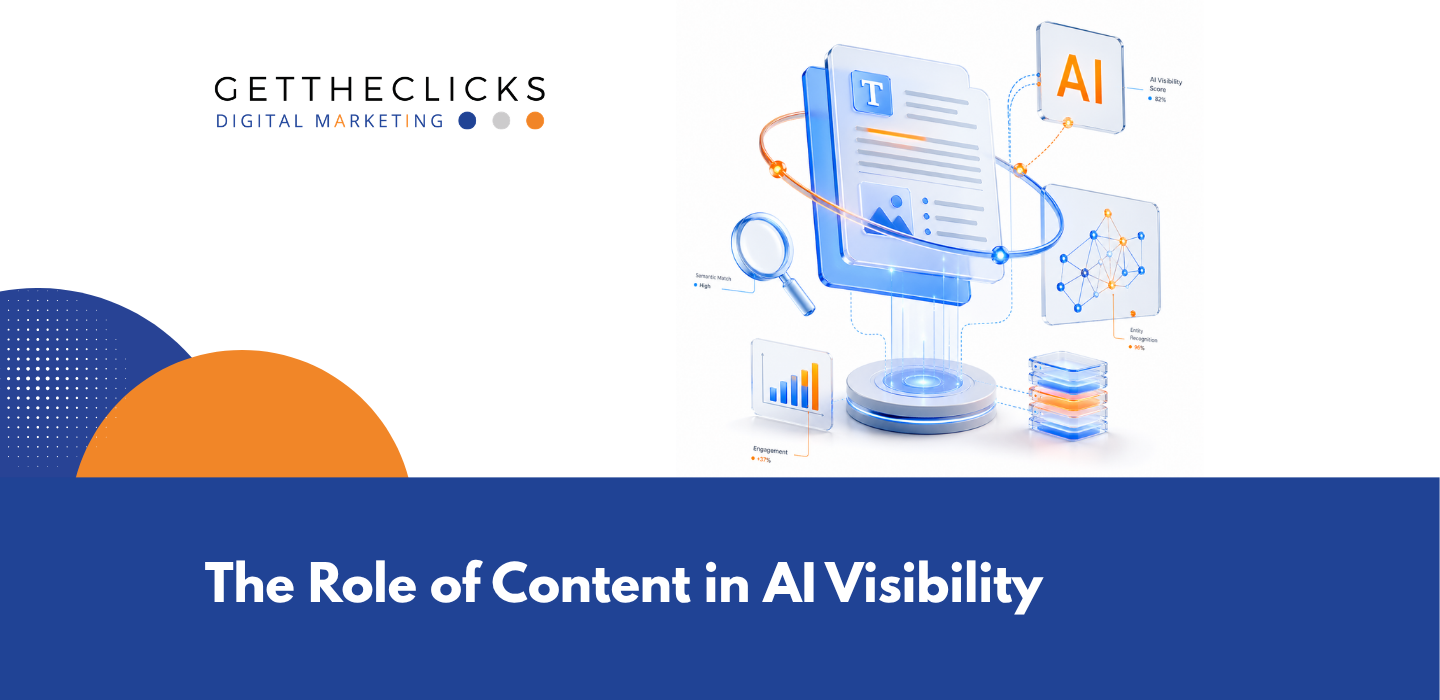
You are no longer writing only for search engines. You are writing for systems that read, interpret, and respond on behalf of users.
To improve AI visibility, your content must clearly answer questions, demonstrate credibility, and present information in a way machines can understand. This shift changes how you plan, write, and structure content. You are no longer chasing rankings alone. You are earning placement inside answers.
Why Content Matters in AI Visibility
AI visibility means your content appears inside generated answers, summaries, and recommendations across search and assistant platforms. Instead of a list of links, users receive direct responses pulled from multiple sources. Your content must be clear enough to be selected and included, which shifts your focus from ranking to inclusion.
AI systems scan for meaning, not just keywords. They identify intent, extract relevant sections, and assemble responses from multiple sources. This means your content must answer questions directly and consistently across sections, rather than relying on general topic coverage.
- AI pulls exact phrases and structured answers
- It favors clarity over clever writing
- It selects content that resolves user intent quickly
Traditional SEO alone does not meet these requirements. Ranking signals still matter, but they do not guarantee visibility in AI outputs. You now need content that explains clearly, proves credibility, and delivers answers in a format that can be extracted without confusion.
How AI Systems Evaluate Content
AI systems assess how directly your content answers a query, which could be one of the key reasons your business isn’t showing up in AI answers. They look at structure, clarity, and how well your content matches user intent. If your content delays the answer or buries it in dense text, it becomes harder for AI to use.
Large language models break content into smaller units and interpret meaning based on context. They scan for relationships between ideas rather than reading from start to finish. This makes structure critical because disconnected ideas reduce clarity and accuracy during summarization.
- Clear headings that reflect real questions
- Direct answers placed early in sections
- Consistent terminology across the page
Authority, accuracy, and clarity directly affect whether your content is selected. Authority signals credibility, accuracy ensures reliability, and clarity allows AI to extract the right meaning. If any of these are weak, your content is less likely to appear in responses, even if it ranks well in search.
The Connection Between E-E-A-T and AI Visibility
Experience shows that your content is based on real-world knowledge. AI systems favor content that reflects actual use, testing, or firsthand insight because it reduces uncertainty. When you include specific details and practical explanations, you strengthen trust.
Expertise appears through precise language and clear explanations. It avoids vague statements and focuses on answering questions completely. You demonstrate expertise when your content removes confusion and anticipates what the reader needs next.
- Mentions from trusted platforms
- Consistent publishing within a topic
- Clear author attribution
Authority grows through consistency and recognition across sources. Trust remains the deciding factor for inclusion in AI-generated responses. If your content appears inconsistent or unclear, AI systems will avoid using it to reduce risk.
Content Formats That Perform Best in AI Environments
Content that answers specific questions performs best and aligns with the new rules of content visibility. Guides, FAQs, and structured explanations align with how users search and how AI delivers answers. When your content mirrors real queries, it becomes easier to match with user intent.
Structured answers improve visibility by reducing the effort required to extract information. AI systems favor content that presents answers clearly at the beginning, followed by supporting details that add context without creating confusion.
- Direct answer in the first sentence
- Supporting detail immediately after
- Clear separation between topics
Concise responses outperform long, unfocused writing. AI prioritizes efficiency, so each sentence should contribute to understanding. Multimedia elements, such as visuals and examples, enhance clarity and engagement, reinforcing the perceived value of your content.
Optimizing Content for AI Retrieval and Summarization
Your content should follow a logical flow that mirrors how questions are asked and answered. Each section should focus on a single idea, with clear transitions that help both users and AI systems follow the reasoning without confusion.
Headings act as structural markers that guide interpretation. When headings reflect real user questions, they improve both readability and machine understanding. A strong hierarchy ensures that key information is easy to locate and extract.
- Short paragraphs with one idea each
- Bullet points for grouped information
- Clear spacing between sections
Internal linking connects related topics and shows depth. When your content is connected, AI systems can better understand the scope of your expertise. Clean formatting and a consistent structure allow AI to extract insights quickly, increasing the likelihood that your content will be included in generated answers.
Capturing and Answering Real User Questions
You need to understand what your audience is actually asking, not what you assume they want to know. AI systems prioritize content that aligns closely with real user intent, so your content must reflect how people phrase their questions in natural language. This requires ongoing research, not one-time keyword planning.
Start by identifying common and emerging questions within your niche. Look at search queries, support tickets, and customer conversations. These sources reveal patterns that help you create content that directly matches user needs and improves your chances of being selected by AI systems.
- Review search suggestions and related queries
- Analyze customer support interactions
- Track repeated questions across channels
When your content answers real questions clearly, it becomes easier for AI to match it with user intent. This alignment increases visibility because your content fits naturally into generated responses without requiring heavy interpretation.
Creating Content That AI Chooses to Cite
AI systems select content that is clear, specific, and easy to reference. If your content includes precise definitions, structured explanations, and well-supported claims, it becomes more likely to be quoted or summarized. You need to write in a way that allows individual sections to stand alone as credible answers.
Original insights play a key role here. When your content includes unique data, observations, or analysis, it stands apart from generic content. AI systems look for information that adds value beyond what is already widely available.
- Include specific examples and data points
- Provide clear definitions and explanations
- Avoid vague or general statements
Depth and specificity increase your chances of being cited. Generic content often gets ignored because it offers nothing new or useful. If your content lacks detail or clarity, AI systems will select a more precise source instead.
The Role of Topical Authority in AI Ecosystems
Topical authority comes from consistent coverage of a subject over time. AI systems evaluate how deeply and consistently you address a topic, not just how well a single page performs. You need a body of content that connects related ideas and builds a clear narrative.
Content clusters help establish this authority. When multiple pieces of content link to each other and cover different aspects of a topic, they signal depth and reliability. This makes it easier for AI systems to trust your content across a range of queries.
- Publish consistently within a defined topic area
- Connect related content through internal links
- Maintain consistent terminology and messaging
Fragmented content reduces confidence. If your content is scattered or inconsistent, AI systems may struggle to determine your expertise. Consistency across topics strengthens your position and increases visibility in AI-generated outputs.
Measuring Content Performance in an AI-Driven Landscape
You need to track how your content performs beyond traditional rankings. AI visibility requires new ways of measuring success, including whether your content appears in generated answers or summaries. This means focusing on visibility, not just traffic.
Look for signals that indicate your content is being used by AI systems. These include increased impressions without clicks, branded search growth, and mentions across platforms. These signals show that your content is influencing responses even if users do not visit your page directly.
- Monitor impressions and zero-click searches
- Track brand mentions and query growth
- Analyze engagement patterns on key pages
Engagement still matters. Content that holds attention and answers questions effectively sends strong signals of value. These signals can influence how AI systems prioritize your content in future responses.
Common Content Mistakes That Limit AI Visibility
Thin or repetitive content struggles in AI environments because it does not provide enough value to be selected. AI systems avoid content that lacks depth or repeats the same ideas without adding clarity. You need to ensure every section contributes meaningful information.
Over-optimization can also reduce effectiveness. When content is written primarily for keywords rather than clarity, it becomes harder to read and interpret. This reduces trust and lowers the chances of being included in AI-generated responses.
- Avoid repeating the same idea across multiple sections
- Focus on clarity instead of keyword density
- Ensure each section has a clear purpose
Content that lacks structure or intent is another common issue. If your content does not clearly answer a question or follow a logical flow, AI systems may ignore it. Surface-level coverage often fails because it does not fully resolve user queries.
Future Trends: How AI Will Continue to Shape Content Strategy
AI-generated answers will continue to become more precise and context-aware. As systems improve, they will rely even more on high-quality, structured content. This means your content must stay clear, accurate, and consistently updated to remain relevant.
Personalization will also play a larger role. AI systems will tailor responses based on user behavior, preferences, and context. Your content needs to be flexible enough to serve different user needs while maintaining clarity and consistency.
- Focus on clear, adaptable content structures
- Keep information updated and accurate
- Address multiple user intents within a topic
Early adopters have an advantage. By aligning your content strategy with AI systems now, you position yourself for stronger visibility as these technologies continue to develop.
Building a Sustainable AI Content Strategy
You need a system that consistently produces content that meets AI requirements. This includes planning, writing, and updating content with a clear focus on user intent and clarity. Consistency is what builds long-term visibility.
Establish processes that ensure accuracy and relevance over time. Content should be reviewed and updated regularly to reflect new information and maintain trust. This prevents your content from becoming outdated or less reliable.
- Create clear content guidelines for structure and tone
- Schedule regular content reviews and updates
- Align content with real audience needs and feedback
Content that remains visible over time is clear, detailed, and consistently maintained. Content that fades often lacks depth or becomes outdated. By focusing on clarity, structure, and ongoing improvement, you create a strategy that supports long-term AI visibility.
Drive Measurable Growth with Get the Clicks
At Get the clicks, we help you create content that earns placement in AI-generated answers and attracts qualified traffic that converts into real business results. Our team builds clear, structured content aligned with how AI systems select and present information. Schedule a consultation and let us plan, write, and refine your content so you stay visible where decisions happen.